Product review
LinfaFlow Drops: What Is in Them, What the Trials Found, and What They Cost
A French maritime pine bark extract sold as drops for legs that swell by evening. We read the trials, the refund policy and the checkout, and wrote down all three, including the parts the seller words carefully.
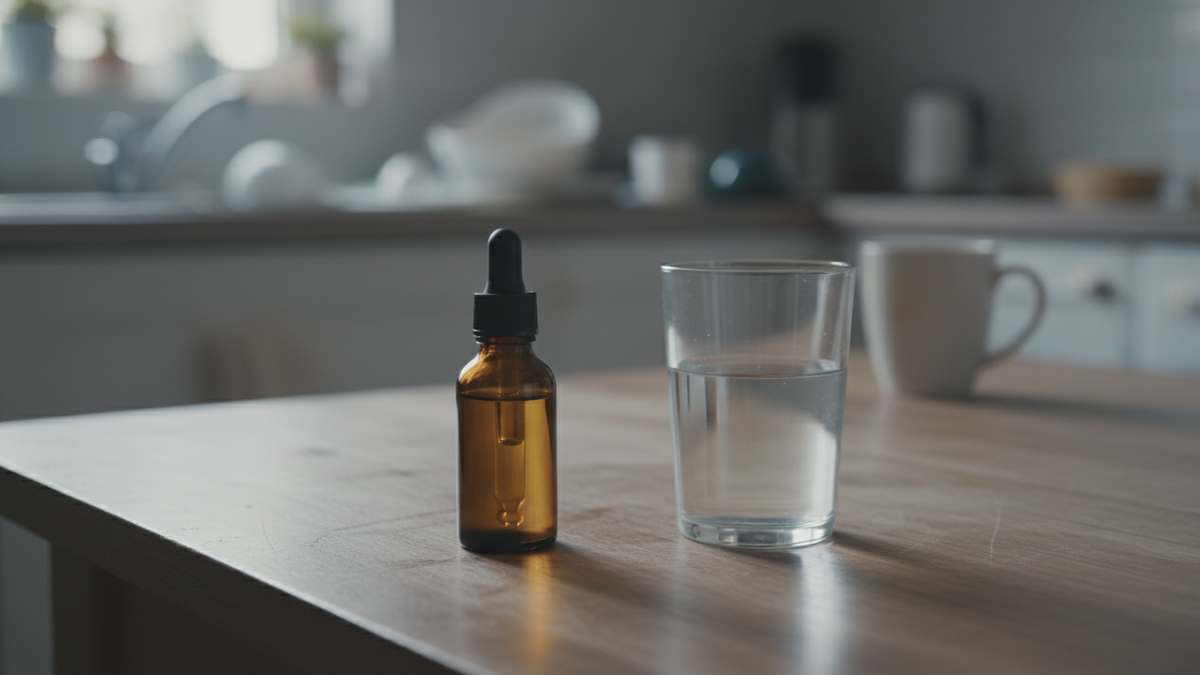
This is the product readers asked about after our page on evening swelling. It is a dietary supplement, we are not the seller, and this page carries an advertising link. What follows is everything we could establish about it from the published trials and from the seller's own pages, laid out in the order somebody deciding whether to buy would want it.
What it actually is
| Form | A liquid in a dropper bottle, taken under the tongue. |
|---|---|
| Stated dose | “One dropper under the tongue, twice a day.” That is the seller's instruction, in full. |
| Named active | French maritime pine bark extract, which the seller calls “Vitamin P”. |
| Other ingredients | The seller says the formula contains four botanicals and names one. The other three are not named anywhere on its pages. |
| Bottle size, servings, milligrams | Not published. There is no supplement facts panel, no millilitre volume and no dose in milligrams on any page we could find. |
| Manufacturing | The seller states the product is made in the United States and that every batch is tested in an FDA-registered facility, and describes itself as GMP-certified. It does not name the manufacturer, the laboratory, the facility registration number or the certifying body. |
| Where it is sold | Its own website only. The seller states it is not sold on Amazon, in Walmart or in drugstores. |
Two of those rows matter more than the rest. A formula that advertises four botanicals and names one cannot be compared with anything, and a product with no milligram figure cannot be compared with the trials — because the trials used a specific amount, and the one below used 300 milligrams a day.
Where the name “Vitamin P” comes from, and what is true about it
The seller attributes the name to the Nobel laureate Albert Szent-Györgyi. That is half right, and the half that is wrong is worth correcting on the page that sells the product.
The name is real. Rusznyák and Szent-Györgyi published Vitamin P: Flavonols as Vitamins in Nature in 1936, DOI 10.1038/138027a0, and the P stood for permeability, meaning the permeability of small blood vessels. Szent-Györgyi did win the Nobel Prize in 1937, and the official citation is for his work on biological combustion, vitamin C and the catalysis of fumaric acid. It does not mention vitamin P.
The name did not survive. A committee formally recommended dropping it in 1950, in a paper in Science whose title is the whole story: Term “Vitamin P” Recommended to be Discontinued, DOI 10.1126/science.112.2917.628.a. The reason, as a later review puts it, is that no deficiency disease could be linked to the extract, which is what a vitamin is defined by — Nutrition Journal, 2017, DOI 10.1186/s12937-016-0218-1.
And the flavonoid fraction Szent-Györgyi worked on came from citrus. The pine bark connection came later, through a French researcher who extracted a similar fraction from peanut skins in 1947 and patented the conifer version in 1964. Calling it a vitamin today is marketing, not chemistry. It does not make the extract useless. It does mean the first sentence of the sales pitch is not accurate.
What the trials found
There are exactly two double-blind, placebo-controlled trials of this extract in chronic venous insufficiency, the condition closest to persistent leg swelling. Between them they studied sixty people, both were run in Italy, and both were published in 2000.
The larger one gave 300 milligrams a day for two months to forty people. Its finding, literally: Approximately 60% of patients treated with Pycnogenol experienced a complete disappearance of edema. No effect was observed in the placebo-treated subjects.
— Fitoterapia, 2000, DOI 10.1016/s0367-326x(99)00164-1. The second, with twenty people in its blinded phase, reported improvement in heaviness and swelling — Phytomedicine, 2000, DOI 10.1016/S0944-7113(00)80059-8.
Those are good numbers and they need three things said next to them. The Cochrane reviewers who went through both studies found that the treated groups started out worse than the placebo groups, by 12 to 25 per cent on swelling, which flatters any improvement. Neither trial reported how it chose its sample size. And neither reported who paid for it.
The wider picture is more useful than either trial. The whole class of these products has been reviewed against placebo across sixty-nine trials and 7,690 people. On swelling, pooling the thirteen trials that measured it in 1,245 people, the verdict is modest and real: Moderate-certainty evidence suggests that phlebotonics probably reduce oedema slightly in the lower legs, compared with placebo
— risk ratio 0.70, with an average reduction in ankle circumference of 4.27 millimetres across fifteen trials, Cochrane Database of Systematic Reviews, 2020, DOI 10.1002/14651858.CD003229.pub4. The same review found side effects rise slightly too, at a risk ratio of 1.14.
But for this ingredient on its own, the same reviewers wrote: Based on very low-certainty evidence, it is uncertain whether French maritime pine bark extract reduces pain, heaviness and swelling.
The class is probably doing something small. Whether this particular member of the class is the reason, nobody can say from what has been published.
The flight study, which is the one everybody quotes
In 169 people who completed a long-haul flight, ankle swelling scores rose 17.9 per cent in those taking the supplement against 58.3 per cent in those not, and ankle circumference rose 6 per cent against 11 — Clinical and Applied Thrombosis/Hemostasis, 2005, DOI 10.1177/107602960501100307.
It is a striking result and it is not a randomised trial. An independent meta-analysis in 2021 classified it as non-randomised, rated its risk of bias as serious, and recorded that the materials were supplied by the manufacturer — Nutrients, 2021, DOI 10.3390/nu13030961. That analysis found a favourable pooled effect on swelling and then said this about it: due to the poor quality and small number of studies, no recommendation for the use of these products can be made until more research emerges.
Who paid for the research
This belongs on any page that sells the stuff. The Cochrane review of pine bark extract covers 27 randomised trials. The company that owns the trademark funded nine of them outright, and the reviewers discovered four more after writing to the authors. Exactly one trial in the entire body of work had confirmed independent funding.
Their overall conclusion, in their words: Small sample sizes, limited numbers of RCTs per condition, variation in outcome measures, and poor reporting of the included RCTs mean no definitive conclusions regarding the efficacy or safety of pine bark extract supplements are possible.
— DOI 10.1002/14651858.CD008294.pub5.
What it is not shown to do
Pages selling this extract tend to promise a list. The list does not hold up, and here is each item with what is actually published behind it.
- Weight loss. The one meta-analysis that measured body weight found it fell by 1.37 kilograms and found no change at all in body mass index, waist circumference or waist-to-hip ratio — BMC Complementary Medicine and Therapies, 2025, DOI 10.1186/s12906-025-04819-9. Weight moving while every measure of body shape does not is an inconsistency, not a result.
- Mental clarity. There is no randomised, blinded trial in healthy adults. The three human studies of cognition describe themselves as registry or product-evaluation studies, have no placebo group, and come from one research group.
- Younger skin. The most quoted study enrolled twenty women and had no control group. The randomised one tested a six-ingredient product, so nothing in it can be attributed to pine bark.
- Joint pain. A real short-term signal exists, graded very low certainty by the reviewers who found it, with no clinically important effect at medium or long term — British Journal of Sports Medicine, 2018, DOI 10.1136/bjsports-2016-097333.
Safety, as far as it has been looked at
The published trials report good tolerability and no notable adverse effects, and that is worth something. It is also worth knowing that the Cochrane reviewers said the trials were too short and too small to assure safety, which is a different statement from finding harm. Anyone taking a prescribed medicine should raise it with a clinician before adding a supplement, and the seller's own label text advises against use while pregnant or nursing.
What it costs
Prices read from the checkout on 15 September 2026. Every bundle ships free, and the per-bottle price is the seller's own figure, not our arithmetic.
2 bottles
$44.75 /bottle
$89.50 total · free shipping
Most popular
4 bottles
$27.49 /bottle
$109.96 total · free shipping
Lowest price
6 bottles
$19.99 /bottle
$119.94 total · free shipping
The six-bottle bundle costs thirty dollars more than the two-bottle one and contains three times as much, which is the only pricing observation worth making: if it is going to be tried at all, the trials that found anything ran for two months, and two bottles at the stated dose is a shorter run than that.
See bundles and prices at the seller
Advertising link to the seller's checkout. This publication is paid a commission if a purchase is made, at no extra cost to the buyer.The refund policy, and the three different numbers
The seller's pages carry three guarantee periods. The advertorial says 60 days, a badge on the checkout says 60 days, the text beside it says 90 days, and the refund policy — the document that actually governs — says 30. Since that is the one that decides an argument, here is what it says.
| Window | Your refund request must be submitted within 30 days of your original purchase date. |
|---|---|
| Automatic? | No. All refund requests are reviewed on a case-by-case basis and are not automatically guaranteed.A request has to give a reason; dissatisfaction with results is listed as an accepted one. |
| Return the bottles? | No. We do not require you to return the product in order to receive a refund. |
| How long | 1 to 2 business days for a reply, 5 to 10 business days for the money. |
| How to ask | By email to the seller's support address, which is on its refund page. |
Two things to watch on the checkout page
Neither is hidden, and both cost money if clicked past.
- An expedited shipping upgrade at $9.95 sits above the payment button, on a page where every bundle already ships free.
- A membership described as free for 14 days renews at $197.00. The price is printed; the renewal is the part people miss.
The checkout also states, on the same screen, both that the order is a one-time purchase with no recurring charge and that refills ship every 30 days with cancellation available at any time. Those two sentences cannot both describe the same order, so it is worth reading which one applies to the option selected before paying.
Our verdict. The honest summary is narrow. The class this product belongs to probably reduces evening leg swelling slightly, on moderate-certainty evidence from nearly eight thousand people. Whether this ingredient is one of the members doing the work is uncertain, on the reviewers' own wording, and the body of research behind it is largely paid for by the company that owns the trademark.
Against that: it is inexpensive at the six-bottle tier, it ships free, the published trials found it well tolerated, and the refund window does not require sending anything back. For swelling that arrives by evening and is gone by morning, it is a small bet on a small effect. For swelling that stays overnight, affects one leg only, or comes with breathlessness, it is the wrong thing to buy and the right week to see a clinician.
Disclosures
Advertising disclosure. This page carries paid advertising links. If a reader follows one and buys something, this publication is paid a commission by the seller, at no additional cost to the reader. That arrangement did not change a single figure above: the trials are cited so that anybody can check them, and the ones that undercut the product are quoted at the same length as the ones that support it.
We are not the seller. This publication does not make, own, stock or ship this product, cannot process an order and cannot issue a refund. Questions about an order go to the seller's support address on its refund page.
Health information notice. These statements have not been evaluated by the Food and Drug Administration. This product is not intended to diagnose, treat, cure or prevent any disease. Dietary supplements are not assessed for effectiveness before they go on sale. Nothing on this page is medical advice or a reason to begin, stop or alter a prescription.