Kitchen safety
Kitchen Safety: What This Section Is, and How It Gets Checked
A standing section about the equipment, packaging and everyday objects in a kitchen, what has actually been measured about them, and the boundary this site will not cross.
Why a recipe site has a section like this
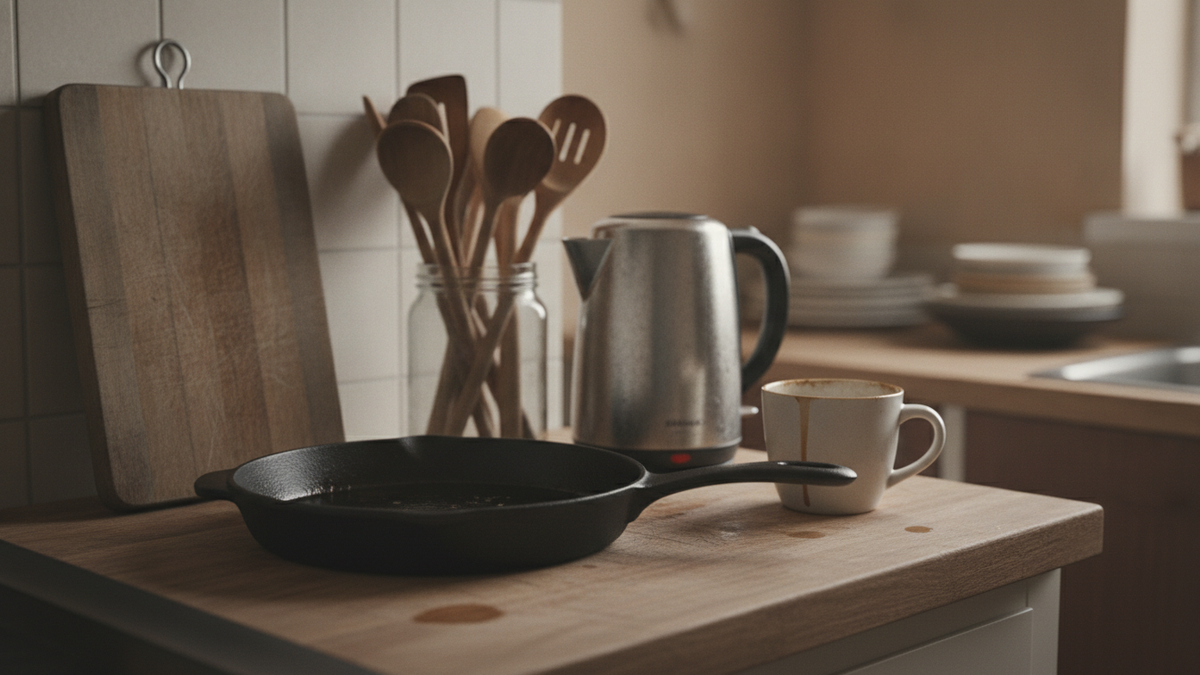
This site is about home cooking and it stays about home cooking. The reason a section like this one exists is that a fair share of the post that arrives here is not about a recipe at all. It is about the equipment, the packaging and the small daily objects that surround the cooking: a pan that has seen better days, a phrase printed on the front of a carton, a device on the kitchen table that gives a different answer twice in a row.
Those questions have two things in common. They are ordinary, and they usually have a real published literature behind them that almost nobody reading a forum thread about them has seen. That combination is worth a section. Kitchen Safety is where those pages go.
What it is not is a change of subject. There is no health desk here, nobody on staff is a clinician, and no page in this section will tell a reader anything about their own body. The subject is the object on the counter and what has been measured about it.
What counts as kitchen safety here
The boundary is deliberately narrow, and it is drawn around things that are physically present in a kitchen:
- Cookware and utensils — what surfaces do as they wear, what has been measured coming off them, and when an item stops being worth keeping.
- Packaging and containers — what has been measured moving from a container into food, particularly under heat.
- Labels and the claims printed on them — what a regulated phrase legally means, which is often narrower than what it is read to mean.
- Water and what reaches it — what has been counted in what comes out of a bottle or a tap, and what a filter is and is not built to remove.
- Instruments people keep in a kitchen — how a home device produces a number, and which ordinary details move that number.
Everything outside that list stays outside it. Conditions, symptoms, treatments, diets prescribed for a reason and medication are all questions for somebody with training and access to a person’s history. They are not questions a kitchen site can take, and pretending otherwise is the most common failure of the genre.
How a page in this section gets made
The procedure is the same one the claims review pages on this site already use, applied to objects instead of preparations. It runs in a fixed sequence.
First, the question gets written as something checkable. “Are nonstick pans bad” cannot be checked. “What has been measured coming off a scratched coating, and did anyone follow it into food” can.
Second, the published work gets found and read, primary sources rather than coverage of them. Where a figure is famous enough to have travelled on its own, the paper it came from gets read specifically to find out what the figure was a measurement of, because that is where most of the drift happens.
Third, and this is the part that takes the longest, the page separates what was measured from what was concluded on top of it by somebody else. A particle count is a particle count. It is not an exposure, it is not a dose, and it is not an outcome, and a page that slides from the first to the last without saying so is doing the thing this section exists to avoid.
Fourth, the page says plainly what nobody has measured. That is the closing block on every article here, and it is not a formality. It is usually the most useful part.
Fifth, the sources are listed in the text itself: journal, year and DOI written out in full, so that anybody can put the identifier into a search and land on the paper. If a page here cites something, the citation is complete enough to check without trusting us.
Three words that do most of the work
Three phrases turn up repeatedly in this section, and they are not interchangeable.
Measured means somebody set up conditions, took a reading, and published the method along with the number. It is the strongest thing we say.
Not measured means the specific question has not been put to a study. It does not mean the answer is no. An unexamined question has no answer yet, and treating absence of evidence as a verdict in either direction is the error we most want to avoid in these pages.
Not supported means a claim has been made and nothing published backs it. That is a judgement about the claim, not about the underlying object, and the two get confused constantly.
Unstudied is not the same as disproven, and it is not the same as safe. Keeping those three apart is most of what this section does.
What this section does not do
Stated flatly, because the reason for a boundary is only credible if the boundary is visible:
- No medical advice. Nothing in this section is a diagnosis, a treatment, or a reason to start, stop or change anything a clinician prescribed.
- No product recommendations. No page here names a brand of pan, bottle, filter or device as the one to get. Where equipment appears, it is what happens to be in this kitchen, described as such.
- No outcome promises. No page here says that changing a pan or a carton will do something for anybody. That sentence has not been earned by any evidence we have read.
- No fear as a format. The measurements in these pages are frequently smaller and narrower than the coverage they generated. Where that is the case, the page says so, including when it makes the article less exciting.
- No hidden method. Every figure here carries a citation in the text, and any page that cannot be sourced does not get published.
Why the citations have no links attached
Sources in this section appear as journal, year and DOI written into the sentence, rather than as links. That is a deliberate choice and worth explaining, since it looks like an omission.
Links rot. A page that cited a publisher URL in 2026 will be citing a redirect in a few years and a dead address after that, and the reader is left with a claim and no way to check it. A DOI written out in full does not rot: it is a permanent identifier, it can be pasted into any search, and it resolves whoever is hosting the paper this year. It also keeps this site from making requests to anywhere else while someone is reading, which is a property we prefer for reasons of plain page loading.
The trade is one extra step for the reader in exchange for a citation that still works later. We think that is the right way round.
The pages in this section
- The Salt Claims on the Front of the Box — what low sodium, no salt added and lightly salted are legally required to mean, and why the phrase that helps a cook most is not the one with the lowest number.
- Reading a Home Blood Pressure Number — why two readings taken minutes apart disagree, told entirely through the cuff, the arm position and whether the device was ever validated.
- What a Scratched Nonstick Pan Releases — what has been counted coming off a damaged coating, what turned up in a food simulant, and the long list of things neither study measured.
- What Comes Off a Cutting Board — what a knife takes out of a board over years of use, and what has been recovered from the food afterwards.
- What's in Bottled Water — what counting methods have found in bottled water, and what a household filter is built to catch.
- The Tea Bag Test — what has been measured coming out of a bag in hot water, and how the numbers changed when better methods arrived.
- Reheating in Plastic — what has been measured moving from a container into food under heat, and which conditions the measurements actually used.
The section will grow, and it will grow slowly, because each of these takes weeks of reading. Readers suggest most of them, and the suggestions that work best are the specific ones: a thing on a counter and a claim attached to it.
Where this sits next to the rest of the site
The recipes are unchanged and remain the reason the site exists. The claims review pages are the closest relatives of this section, since they apply the same evidence test to preparations rather than to objects: the claims review of the honey, garlic and cinnamon drink, and the one covering the beet, lemon and ginger morning drink, both work through a list of statements and report which ones anybody has actually checked. The method notes in In the Test Kitchen cover how a preparation gets tested here before it goes up, and the About page states the editorial position, the corrections procedure and how the site is paid for.
What we still don’t know
- We do not know how much of the published work on any of these questions we have missed. Searching is not systematic review, and this is a small publication.
- Several of these topics are moving. Better methods find more, which sometimes means a figure from a few years ago was an underestimate and sometimes means it was an artefact of the method. Where that is likely, the page says so.
- Nothing in this section establishes what any of it means for a person, and that gap is not one more studies here would close. It is a different kind of question with a different address.
- We do not know whether this section is the right shape. It is new. If a page is unclear, wrong, or over-stated, the address for saying so is on the contact page, and the review date on any article moves when it is corrected.
General information about food and kitchen equipment, which is what this site publishes. Not medical advice, and no replacement for asking somebody qualified who knows the rest of the picture. Nothing here is a reason to begin, stop or alter a prescription.