Reheating in Plastic
Nobody reheats water, which is what almost every study used. What changes when heat and fat arrive together in a takeaway tub, what the symbol on the base of the container actually promises, and four claims the evidence does not carry.
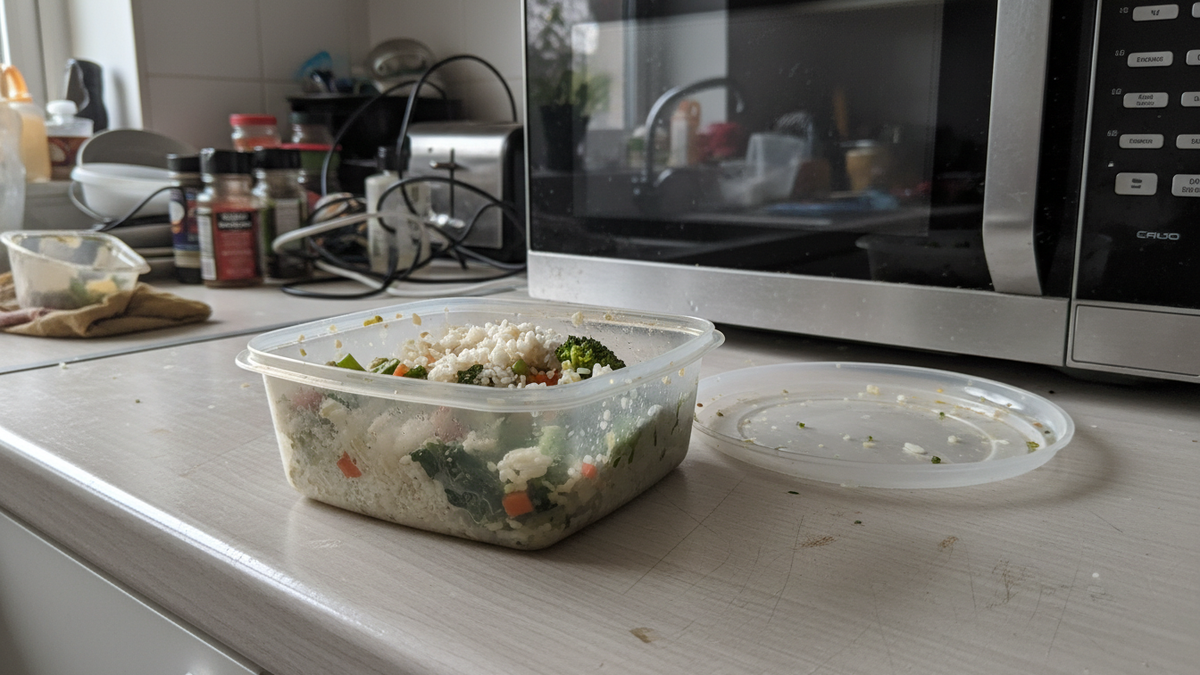
The tub of chilli, which is the actual question
Nobody reheats water. What goes into the microwave in a plastic tub is last night's chilli, a curry, something with oil in it, something acidic, something that came home from a restaurant in the container it is now being heated in. That combination — heat, fat, time, a container designed for one trip — is the case worth writing about, and it is the case most of the published work does not cover.
So this is what has been measured, what follows from the chemistry without having been measured directly, and the list of things people say about this that the evidence does not support. The third list is longer than I expected when I started.
What heat does
The clearest measurement in this area did not involve a microwave at all. A team publishing in Nature Food in 2020 — DOI 10.1038/s43016-020-00171-y — worked with polypropylene infant feeding bottles, filled them with water at 70 degrees Celsius, about 160 Fahrenheit, as the preparation instructions specify, and counted what came off the inside. The counts ran into the millions of particles per liter, and the important part is not the number. The important part is the curve: release climbed steeply with temperature. Warm was one thing, hot was another, and the relationship was not gentle.
That is a bottle rather than a takeaway tub, and water rather than food, so it transfers to the kitchen as a mechanism and not as a figure. The mechanism is the transferable part. Polymers soften as they warm, the surface becomes more willing to give things up, and everything in this subject accelerates with heat.
Later work extended the same approach to food containers and reusable pouches, published in Environmental Science & Technology in 2023, DOI 10.1021/acs.est.3c01942, and found the same direction of travel: three minutes in a microwave released more than refrigeration or room temperature storage did.
What fat does, and why it is missing from most studies
Counting particles is one thing. Migration is another, and it is where fat earns its place in the headline of this article.
The additives that make a plastic flexible, stable and heat-tolerant are not bonded into the polymer chain. They sit among it, and they move — slowly at room temperature, faster when warm, and much faster into fat than into water, because most of them dissolve in oil and barely dissolve in water at all. This is settled chemistry and it is the reason food-contact testing uses fatty simulants as a separate category from watery ones.
Which means the honest statement about a tub of chilli is this: the particle-counting studies used water, the migration research uses standardized simulants, and almost nobody has run the experiment that matches what is actually in the tub. The direction is clear. The quantity is not.
Heat and fat also arrive together in a microwave, and unevenly. A microwave does not warm a tub to a temperature; it creates hot spots, and the oil in a sauce reaches them first because oil takes heat past the boiling point of water without announcing it. The number printed on the base of the container assumes an even bath. It is not describing what happens to the corner where the sauce is bubbling.
What the label on the bottom means
A microwave symbol on a container is a structural statement. It means the container has been shown not to warp, melt, crack or catch fire in normal microwave use. It is a promise about the container surviving the food.
It is not a statement that nothing moves from the container into the food, and it was never written to be one. Manufacturers are not being sly about this — the mark simply means what it means, and the gap is entirely on the side of readers, myself included, who assumed a symbol answered a question it does not address.
The study that got corrected
This one belongs in the article because of how it went, not because of what it found.
In 2024, a paper in Chemosphere reported flame-retardant compounds in black plastic kitchen utensils, which makes sense as a finding: black plastic is often molded from recycled electronics, and electronics casings are treated with flame retardants. The measurements stood. What did not stand was a comparison in the discussion, which contained an arithmetic error and put the estimated exposure far closer to a reference limit than the figures actually supported. The authors corrected it, and the correction moved the estimate by an order of magnitude.
The finding survived. The alarm did not. That is a good reason to keep black plastic away from a hot pan, since polymers and heat are the whole subject here, and a very bad reason to panic — and it is a useful reminder that the loudest number in a piece of coverage is the one least likely to have been checked.
Four things the evidence does not support
- That switching containers changes a health outcome. Nothing has been measured. There is no study in which people changed what they reheat food in and anything at all was tracked afterwards.
- That "BPA-free" means inert. It means one named compound was left out. The substitutes are less studied, not better studied, and a label describing an absence is not describing what is present.
- That glass is risk-free. Glass does not shed polymer, which is a real advantage. It also shatters under thermal shock, and a chipped rim on a storage dish is a hazard nobody writes articles about. Glass is better understood, which is not the same as perfect.
- That any particular count corresponds to an effect. There is no established quantity of plastic particles at which any of this produces a measurable result in a person. Any article that tells you how many is inventing a scale.
What I do now, which is two changes and no purchases
Food goes into the tub cold or barely warm, not straight off the stove. A skillet of Sausage and White Bean Skillet sits out until it stops steaming before it goes into anything. That is the one change with a mechanism behind it that I would defend, since hot fat hitting a cold tub is the exact condition everything above describes.
And it comes out of the tub before it goes in the microwave. Into a ceramic bowl, lid off, a plate on top, ninety seconds, stir, ninety more. It adds one bowl to the sink. Smoked Paprika Lentil Soup reheats better in a bowl anyway, because a microwave heats a shallow layer more evenly than a deep tub, which is a cooking reason rather than a safety one and was true before any of this.
What I did not do is buy a set of glass containers. The tubs are fine for cold storage in the fridge, which is where the release research says the least is happening, and replacing a cupboard full of usable containers on the strength of a mechanism nobody has sized in food would be spending money to feel better. Restaurant tubs do get retired once they cloud or scratch, on the same reasoning as a grooved chopping board: a surface that has been worn open gives up more than a smooth one.
What we still don't know
- What comes off a container into actual food — fatty, acidic, salted, hot — rather than into water or a laboratory simulant.
- Whether a scratched, dishwashered, three-year-old tub behaves differently from a new one. It ought to. Nobody has shown it.
- What quantity, of anything measured here, matters to a person.
- What the replacement compounds in the products sold as free of the old ones actually do, given that they are newer and thinner on published work.
The pattern across this whole editorial section is the one this site keeps running into. Something real has been measured, the measurement is honest, and the distance between that measurement and a claim about a reader's health is enormous and gets jumped in a single sentence by people who are selling something. Claims Review: The Honey, Garlic and Cinnamon Drink found the identical move in an entirely different aisle.
Editor's note: food storage and the research behind it, reported as it stands. Kitchen information, not medical advice. Nothing on this page should displace what a clinician has instructed.