What a Scratched Nonstick Pan Releases
A four-year-old skillet with bare metal showing sent me to the published work on coated pans. What has been counted coming off a damaged coating, what turned up in food, and the longer list of things nobody has measured.
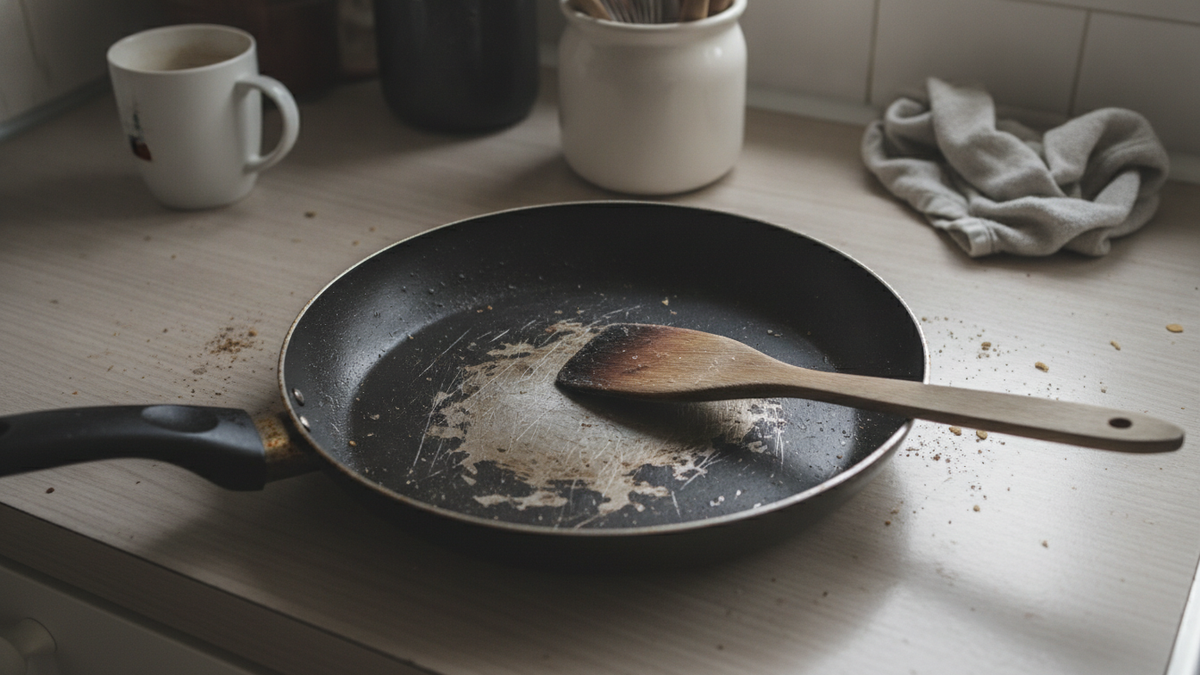
The pan I kept too long
There is a ten-inch coated skillet in this kitchen that did four years of eggs before I looked at it properly. Held at an angle under a window, the surface had gone from even black to a dull grey field with a bright scratch running across it and a patch near the handle where the metal underneath showed through. I had noticed the scratch at some point and decided it was cosmetic. That decision was not based on anything.
So I went and read what has been measured, which is more than I expected and less than the confident posts about it suggest. Here is the whole of it: what the coating is, what has been counted coming off it, what turned up in food, what nobody has measured at all, and the point at which a pan leaves this kitchen.
What the coating is
The slippery layer on most coated pans is PTFE, polytetrafluoroethylene, a fluoropolymer applied as a thin film over metal and baked on. It is not a metal treatment and it is not a seasoning like the one that builds on cast iron. It is a plastic layer sitting on top of a pan, mechanically bonded, a few tens of micrometres thick on a typical domestic skillet.
That framing is the one worth carrying, because it makes the question ordinary. A thin plastic film, scraped daily with metal and heated and cooled a few thousand times, will wear. The interesting question is not whether anything comes off. It is what comes off, how much, and whether anybody has followed it anywhere.
What one crack was measured to release
The measurement most often quoted comes from Luo and colleagues, Science of the Total Environment, 2022, DOI 10.1016/j.scitotenv.2022.158293. The group used Raman imaging together with an analysis routine built to pick out very small plastic fragments against a noisy background, and applied it to coated pan surfaces in various states of damage.
Two figures came out of that work. A single surface crack was associated with the release of roughly 9,100 plastic particles. A coating in broken condition released on the order of 2.3 million plastic particles and fragments, most of them far too small to see, many below a micrometre.
Both numbers deserve careful handling, and the paper handles them carefully even where the coverage of it did not. They describe what came off a surface under the conditions the group set up and measured with the method they built. They are counts of particles released, not counts of particles eaten, and the authors do not present them as the latter.
What turned up in the food
The study that moves closer to a plate is Cole and colleagues, Science of the Total Environment, volume 929, 2024, article 172577, DOI 10.1016/j.scitotenv.2024.172577. Instead of examining a surface, they took a food simulant through ordinary preparation steps using different cookware and then looked at what was in it afterwards.
The results split cleanly. Non-plastic cookware did not introduce plastic fragments into the simulant. Plastic cookware and coated items did, both new and worn, and the particles recovered ran from about 13 to 318 micrometres. From that the authors estimated a contribution in the range of roughly 2,409 to 4,964 particles a year into home-cooked food.
Worth noticing in that design: the cookware category mattered more than the age of the item. New plastic cookware contributed as well. A scratched pan is a sharper version of the question, not the only version of it.
What none of this measured
This is the section most pages on this subject leave out, and it is the section that decides what a cook should do with the numbers above.
- Nobody measured what happens to those fragments afterwards. Neither study followed a particle past the food. Absorption, passage, accumulation: not measured here, and not claimed.
- Nobody measured an outcome in a person. No trial has been run that takes people cooking on damaged coated pans, follows them, and reports what happened. That study does not exist, and no amount of particle counting substitutes for it.
- Nobody established a dose that means anything. A count of several thousand particles a year sounds large and has no reference point attached, because there is no established figure to compare it against.
- Nobody measured this kitchen. The laboratory damage was made deliberately and characterised precisely. A four-year-old skillet with one long scratch is not the same object.
The honest summary is the one this site keeps arriving at: something real has been measured, the measurement is narrower than the headlines it produced, and the step from measurement to consequence has not been taken by anyone. Unstudied is not the same as harmless, and it is not the same as harmful either.
Heat is a separate question with a separate answer
The other literature on these pans has nothing to do with scratches. Sajid and Ilyas, Environmental Science and Pollution Research, 2017, volume 24, pages 23436 to 23440, DOI 10.1007/s11356-017-0095-y, set out, in a piece they call a perspective rather than a review, what is known about PTFE cookware and the compounds it can release when heated, including reports of detection in the gas phase at cooking temperatures, and the historical use of perfluorooctanoic acid in manufacturing the polymer. That compound was phased out of production by the major manufacturers over a decade ago, which changes the story for a pan bought recently and does not change it for a pan that has been in a cupboard since before then. The same authors add the caveat that the replacements brought in for it are themselves suspected of similar toxicity, which is a sentence worth reading twice before treating a new pan as a solved problem.
The temperature part is simple enough to act on. The coating is stable through normal cooking and degrades when a pan is taken well above it, and the fastest way to reach that state by accident is an empty coated pan left on a high burner while something else is being dealt with. A pan with food or fat in it is being held down by what is in it. An empty one is not, and it climbs quickly.
So: nothing empty on high, no broiler, no oven pass unless the manufacturer specifically allows it, and the searing work goes to a different pan. That is not caution about scratches. It is a different mechanism with a different fix, and the two get run together constantly.
When a pan leaves this kitchen
A rule I can apply while standing at a sink, which is the only kind that survives: the pan goes when the coating is no longer continuous. Bare metal showing, a flake lifting at an edge, or a scratch deep enough to catch a fingernail. Colour change alone does not count, and neither does food starting to stick, which is usually a film of polymerised fat and comes off with a soak.
The things that got the skillet there, in the order they mattered: metal utensils, stacking pans inside each other without anything between them, and taking a hot pan to a cold sink. Cutting in the pan is the one I still catch myself doing, and it is the most destructive of the four.
What I use now for the dishes that used to go in it: a well-kept cast iron skillet for eggs, which took a few weeks of patience to get right, and stainless with enough fat and enough patience for everything else. The spinach and feta baked eggs go in a cast iron pan to the oven and are better for it. The skillet gnocchi with spinach wants the browning that a coated pan never gave it. The one genuine loss is a delicate fish fillet, and that is a real loss rather than a rhetorical one.
None of that is a recommendation to go and replace anything. It is what happened here after reading the papers, written down so that the reasoning is visible and can be disagreed with.
What we still don’t know
- Nobody has measured a worn domestic pan in a domestic kitchen over its actual life. Both studies above created or selected damage under controlled conditions, which is how such work has to start and is not the same thing.
- Whether particle release keeps rising as damage spreads, levels off, or depends mostly on how the pan is used has not been characterised.
- Nothing has been measured about what happens after ingestion, in either study cited here. Pages that continue the sentence past the pan are continuing it on their own.
- The comparison against every other route by which fragments reach food in a kitchen has not been done in a single design, so the pan’s share of the total is unknown.
- We have no figure for how many pans in ordinary use are actually in the damaged state these measurements describe. My own was, and one pan is not a survey.
This article belongs to the Kitchen Safety section, which collects the objects a kitchen uses daily and asks what has actually been measured about them. The same evidence test runs on the preparation pages here, such as the claims review of the honey, garlic and cinnamon drink, and the method behind all of it is set out on the About page.
General information about food and kitchen equipment, which is what this site publishes. Not medical advice, and no replacement for asking somebody qualified who knows the rest of the picture. Nothing here is a reason to begin, stop or alter a prescription.