The Tea Bag Test
A mesh pyramid comes out of the mug in the same shape it went in, which paper never does. What the published work measured, and the ten-minute test at my own stove that tells you which of your bags are plastic.
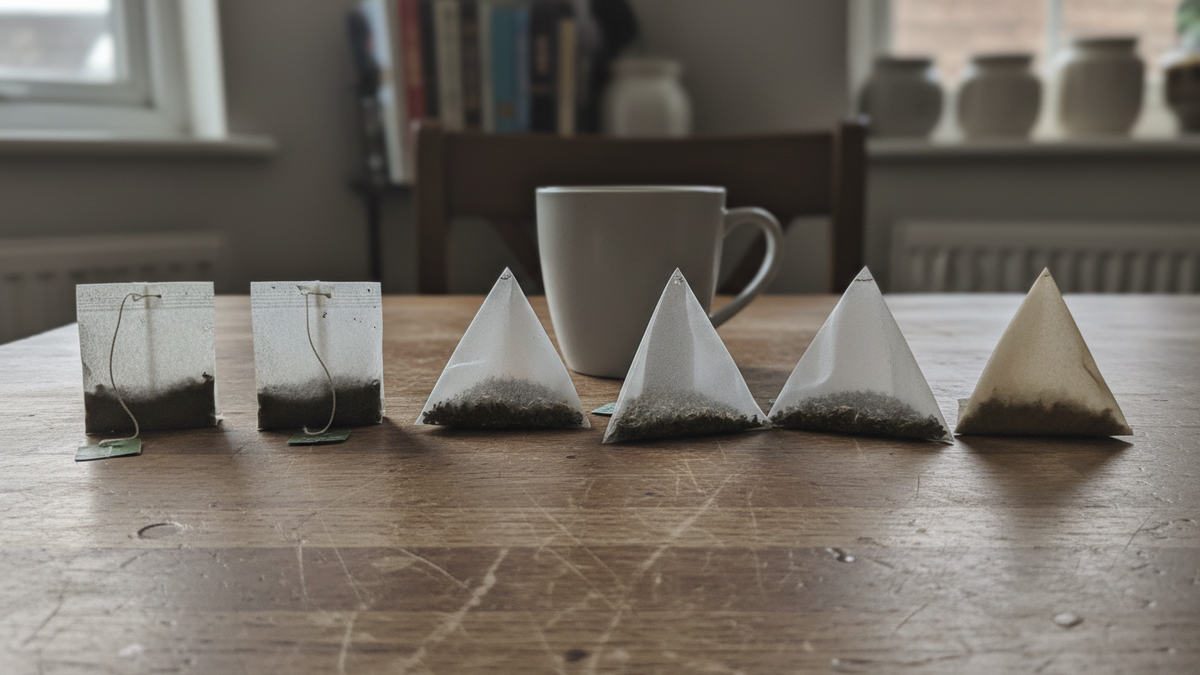
The bag that holds its shape
I noticed it first with an expensive tea. The bag was a tidy little pyramid, translucent, and when I fished it out of the cup after four minutes it came out looking exactly as it had gone in — no sag, no tear, no pulp. Paper does not do that. Paper goes soft and heavy and gives up the moment you press it against the side of the mug. Whatever that pyramid was, it was not paper, and it had just spent four minutes in water hot enough to hurt.
That is the whole origin of this piece. Not a headline, a bag that behaved wrong.
What is in a tea bag
Three broad kinds sit on the shelf, and they are easy to tell apart once you know they are different.
The flat paper bag is mostly plant fiber, frequently with a small proportion of thermoplastic fiber blended in so that the seams can be closed with heat rather than glue or a staple. That proportion is usually small and almost never printed on the box.
The mesh pyramid is a woven or spun polymer — nylon or PET in most cases. It is not a paper bag with a fancy shape. It is a different material chosen because it holds a shape, lets whole leaves move, and looks like quality on a shelf.
The compostable pyramid is usually PLA, made from plant starch. Compostable describes what happens to it in an industrial composting facility, and plant-based describes the feedstock. Neither word describes how it behaves in a mug at brewing temperature, and that is the only question this page is about.
What was measured
The study everybody cites is a good one. A group at McGill published in Environmental Science & Technology in 2019 — DOI 10.1021/acs.est.9b02540. They took mesh bags, emptied the tea out of them so that only the bag was being tested, rinsed them, and steeped the empty bag in water at 95 degrees Celsius, which is about 203 Fahrenheit and is where properly brewed black tea sits. Then they counted the plastic particles left behind in the water.
The figure was billions of particles from a single bag — 11.6 billion in the larger range they measured and 3.1 billion in the smaller one. Those numbers get quoted with a lot of italics attached, so three things about them are worth stating flatly.
The bags were emptied first, which is good method and also means the experiment is not quite a cup of tea. A billion particles at those sizes is a very small amount of matter by weight; the count is enormous because the objects are tiny, not because much material moved. And the study counted what came off. It did not follow it anywhere afterwards, did not measure anything in a person, and made no claim about consequence. The authors were careful. The coverage was not.
The test I ran at my own stove
I could not count anything. No home method counts particles at any size that matters, and anyone who tells you otherwise is selling something. What I could do is find out what my own bags are made of, which is a real question with a real answer that takes about ten minutes.
I pulled six kinds out of the cupboard: three supermarket flat bags, two mesh pyramids, one compostable pyramid. Then, over the sink with the vent fan on:
- The stretch. Wet each empty bag and pull gently at a corner. Paper tears with a soft ragged edge. Mesh stretches first and then gives way in a line.
- The flame. This one I did once, and I am describing it rather than recommending it. Paper charred, glowed at the edge and left ash behind. The nylon and the PET shrank away from the heat before they caught, melted into a hard bead that cooled shiny, and smelled sharp rather than smoky. The bead is unmistakable, and it is also the reason I stopped after one: the two bags whose material I already knew behaved exactly as the box said they would, so this told me nothing that looking at the seam had not already told me.
- The seam. Look at how the bag is closed. A glossy pressed line is a heat seal, which means thermoplastic in the seam even on a bag that is otherwise paper. A folded top with a metal staple or a knotted string is not.
Results in my cupboard: both pyramids beaded, obviously. The compostable one beaded too, softer and at a lower heat, which is what PLA does — still a polymer, still melting. Two of the three flat paper bags had glossy heat-sealed seams. One was folded and stapled with the string, and that was the cheapest box on the shelf.
What that test tells you is which of your bags contain plastic. What it tells you about what comes off them in the cup is precisely nothing, and I want to be exact about that, because a test that feels conclusive while answering a different question is the most common way a kitchen note goes wrong.
What the temperature does
Across this whole subject, heat is the variable that moves everything. Water at 95 degrees Celsius, which is what good black tea wants, is near the top of what any of these materials were designed to meet. Green tea brewed properly at 80 degrees, roughly 175 Fahrenheit, is a gentler proposition. Cold brew, left in the fridge overnight, is gentler still by a wide margin.
Steeping time matters less than temperature, and squeezing the bag against the side of the mug with a spoon has not been measured at all, though the mechanical argument for not doing it is the same as the argument about a scratched chopping board: pressing on a material is how material comes off it. That is reasoning rather than evidence, and it is labeled as such.
What I changed
Loose leaf in a steel basket for anything I drink daily. It is cheaper per cup, the leaves are visibly better because they are not the dust that goes into bags, and the basket goes in the dishwasher. This is not a sacrifice; it is the upgrade I had been putting off for years and the research merely gave me a reason to stop putting it off.
Bags when traveling, and I buy the stapled paper ones now. I stopped squeezing the bag. And the hot water that goes over loose leaves is the same water discussed in Honey, Garlic and Cinnamon: A Traditional Morning Preparation, where the instruction is warm and not boiling for an entirely different reason — taste — and where the same caution about pressing things applies to the crushed clove for no reason at all except that it makes a better drink.
What we still don't know
- What a full bag releases, with tea in it. Every published figure is for an emptied bag, because that is the clean experiment, and a real cup has leaves, tannins and oils in it that could plausibly change the answer in either direction.
- What the small amount of thermoplastic in a heat-sealed paper bag contributes, which as far as I can find has not been isolated and measured at all.
- Whether PLA behaves better or worse than nylon in hot water. Everyone assumes better. Assumption is not measurement.
- What any of this means once it is drunk, which is the question everyone actually has, and on which there is nothing to report.
That last one is not a dodge. It is the state of the field. Tea is not the reason this site exists, and the answer here matches the one in Claims Review: The Honey, Garlic and Cinnamon Drink: somebody measured a thing, the thing is real, and the leap from the measurement to a health outcome was made by a writer and not by a researcher.
Editor's note: tea, equipment, and the measurements published on both. Written as information, not medical advice; anything involving a prescription belongs with whoever signed it.