Reading a Home Blood Pressure Number
Two readings taken minutes apart on the same device often do not agree. Most of the reason is the cuff, the arm and whether the machine was ever tested against a reference. This is about the instrument, not about anybody.
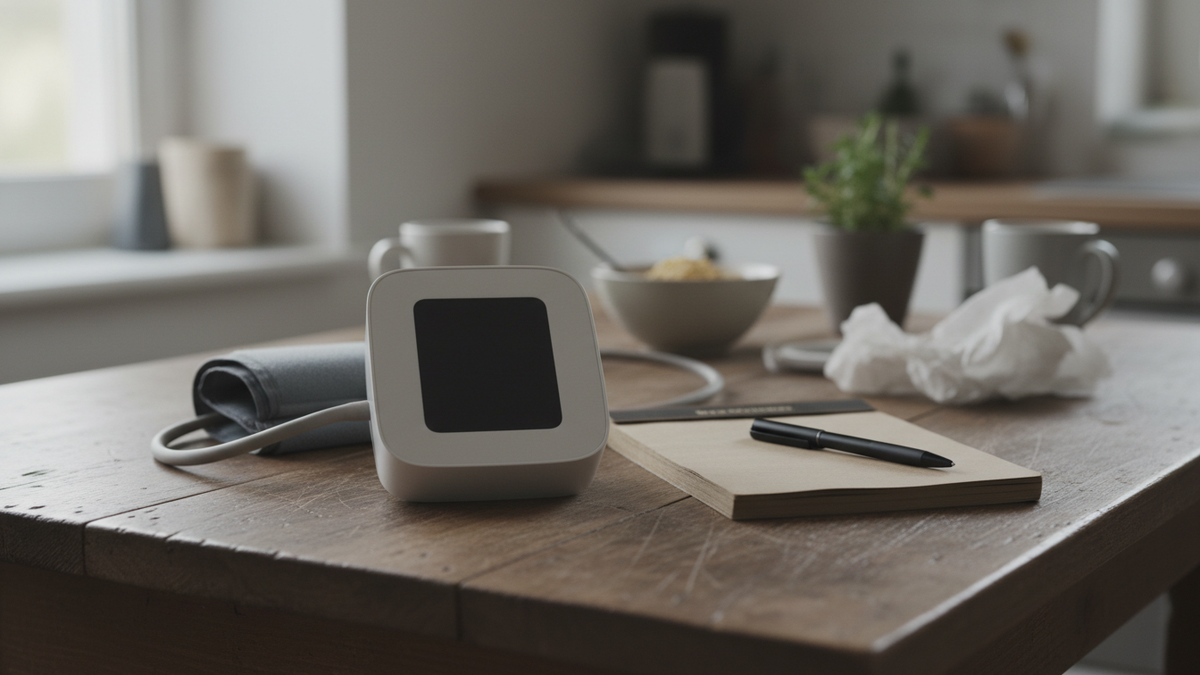
Two readings, five minutes apart, that did not agree
A reader wrote in with a notebook page, and the notebook page is the reason for this article. Two columns of numbers taken on the same device, same kitchen table, same morning, minutes apart, and the columns did not match. The question attached was simple and fair: which one is real, and what is the machine doing?
That question is answerable, and the answer is almost entirely about the instrument and the way it is being used. This is a kitchen site, so what follows stays on that side of the line: what the cuff is, what it is measuring, and which ordinary details move the number it prints. Nothing here is about what any number means for any person. That belongs with a clinician who has the rest of the picture, and it is not something a page can do.
The cuff is an instrument, and instruments have sizes
The band is not a passive sleeve. It is the measuring element. It inflates until flow stops, releases in a controlled way, and the device reads the pressure oscillations coming back through the bladder inside the cuff. If the bladder is the wrong length for the circumference it is wrapped around, the pressure it has to reach in order to do that changes, and the number changes with it.
The size of that effect has been measured directly. Ishigami and colleagues, JAMA Internal Medicine, 2023, DOI 10.1001/jamainternmed.2023.3264, ran a randomized crossover trial in Baltimore with community-dwelling adults spanning a wide range of mid-arm circumference. Each person was measured with the cuff their arm called for and with a regular cuff, in randomized sequence.
The mismatch did not produce noise. It produced a consistent direction. A regular cuff used on an arm that should have had a larger one read high, by as much as 19.5 mm Hg at the top end of arm size. A regular cuff used on an arm that should have had a smaller one read low, by about 3.6 mm Hg. Nineteen and a half points is not a rounding difference. It is larger than most of the gaps people write into a notebook and then try to explain.
Practically, the cuff that came in the box is one size. Arms are not one size. Most manufacturers sell the other sizes separately and print the range the cuff covers on the cuff itself, usually in centimetres, near the edge. Measuring the arm once with a tape at the midpoint between shoulder and elbow settles the question permanently and takes a minute.
Where the arm is sitting
The second measured factor is position, and it is the one most likely to differ between two readings taken minutes apart, because nobody sits the same way twice without deciding to.
Liu and colleagues, JAMA Internal Medicine, 2024, DOI 10.1001/jamainternmed.2024.5213, took 133 adults and measured each of them three ways in randomized sequence: arm supported on a desk, hand resting in the lap, and arm hanging unsupported at the side. Against the desk position, the lap reading came out 3.9 mm Hg higher on the upper number and 4.0 higher on the lower one. The unsupported arm at the side came out 6.5 higher on the upper number and 4.4 on the lower.
Two things follow from that, and the second is the one that matters for a notebook. First, the positions are not equivalent, so a device used in a chair without a table is not producing the same measurement as the same device used at a table. Second, a person who takes one reading with the arm on the table and the next one with the arm in the lap has introduced a difference of several points for reasons that have nothing to do with anything except furniture.
The measurement procedure published by Muntner and colleagues as an American Heart Association scientific statement, Hypertension, 2019, volume 73, pages e35 to e66, DOI 10.1161/HYP.0000000000000087, is specific about the rest of the setup as well: back supported, feet flat on the floor, legs uncrossed, cuff on a bare upper arm at the level of the heart, several minutes of sitting still beforehand, and no talking during the reading. None of that is ceremony. Each item on the list is there because somebody measured what happens when it is skipped.
Most devices sold online have never been tested against a reference
Here is the part that surprised me, and it is the strongest argument for treating a home number as an instrument reading rather than a fact. A validated device is one that has been tested against a reference method under a published protocol and passed. Validation is not automatic, and it is not implied by a device being sold.
Picone and colleagues, Hypertension, 2020, volume 75, pages 1593 to 1599, DOI 10.1161/HYPERTENSIONAHA.120.14719, went through 59 online businesses selling 972 unique home devices available to buyers in Australia and checked how many had been validated. Among the international online sellers in that sample, 5.5 percent had. The unvalidated devices were also the cheaper ones: a median of 67 Australian dollars against 101 for the validated ones.
The consequence is not that unvalidated devices are all wrong. It is that nobody can say how wrong any individual one is, in which direction, or whether the error is stable across the range. A device that reads four points high every single time is far more useful than a device that reads four points off in an unknown direction, and validation is the only thing that distinguishes those two cases.
Two more instrument details belong in the same paragraph. Cuffs stretch and bladders age, which is why manufacturers give the cuff a replacement interval and print it in the manual. And a device that has been dropped has no way of telling anybody that it has been dropped.
Wrists are a different problem
Wrist devices are popular because they are small and because wrapping a wrist is easier than getting a sleeve off. The difficulty is geometric. Pressure in a column of fluid varies with height, so a wrist held in the lap and a wrist held at chest level are being measured at two different heights, and the device has no idea which one it is at. Some models include a position sensor and refuse to read until the wrist is placed correctly, which is a real feature and worth looking for. Where there is no sensor, the height is the user’s responsibility, and the error it introduces is silent.
The American Heart Association statement cited above treats the upper arm as the standard site for this reason, and the validation protocols were built around it.
Why a single number is not a measurement
A display shows three whole numbers and no interval around them, which makes a reading look far more definite than it is. What the device actually produced is a single estimate from an algorithm applied to one inflation cycle, on one arm, in one posture, at one moment.
That is why every published procedure asks for several readings and an average rather than one and a verdict, and why the first reading in a sitting is routinely the odd one out: the person has just sat down, rolled a sleeve up, and started concentrating on a machine. The practice of taking two or three readings a minute apart and averaging them is not a way of picking the answer you like. It is the way the measurement is defined.
So the notebook with two disagreeing columns is not a puzzle about the body. It is a description of two different measurement conditions, and the useful move is to eliminate the differences between them rather than to interpret the gap.
How a reading gets written down around here
The house rule for any number this site publishes is that the conditions get recorded next to it, and there is no reason for a kitchen-table measurement to be treated more casually than an oven temperature. What that looks like in practice: the arm circumference measured once and the correct cuff bought; the same chair and the same table each time; the sleeve off rather than pushed up; five minutes of sitting first; three readings a minute apart with the average written down; the time of day recorded, because time of day is itself a variable; and the device model and its validation status noted at the top of the page, once.
A notebook kept that way answers a question a notebook of loose numbers cannot: whether something moved, or whether the conditions did. That is the only thing a home log can establish on its own, and it is worth a great deal to whoever reads it next.
What we still don’t know
- How much of the spread in a typical home notebook comes from technique and how much from ordinary variation across a day is not something we found measured for people logging at home without supervision. The trials above measured one factor at a time, under supervision, on purpose.
- The cuff-size and arm-position trials were both run in Baltimore by overlapping groups. The effects are clean and they replicate the direction anyone would predict, and they are still two rooms in one city.
- Picone counted devices in the Australian online market in 2020. What the same count looks like in the United States today, after several years of new models, we do not know.
- How quickly cuffs actually drift with use, as opposed to the replacement interval printed in a manual, does not appear to have been measured in ordinary households.
- Nothing here says what any reading means. Not the average, not the spread, not the difference between two arms. That is not a kitchen question and this page does not answer it.
This page belongs to the Kitchen Safety section, which exists for questions like this one: things that sit on a kitchen table, get used daily, and turn out to have a literature behind them. The Salt Claims on the Front of the Box is the nearest neighbour to it, since both are about a number somebody else produced and handed over without the conditions attached. The evidence test behind all of these pages, and the corrections procedure, are set out on the About page.
General information about food and kitchen equipment, which is what this site publishes. Not medical advice, and no replacement for asking somebody qualified who knows the rest of the picture. Nothing here is a reason to begin, stop or alter a prescription.