What Comes Off a Cutting Board
A scratched plastic board loses a little of itself every time a knife crosses it. Here is what has been counted, what the counting cannot tell anybody, and the one thing I changed in my own kitchen after reading it properly.
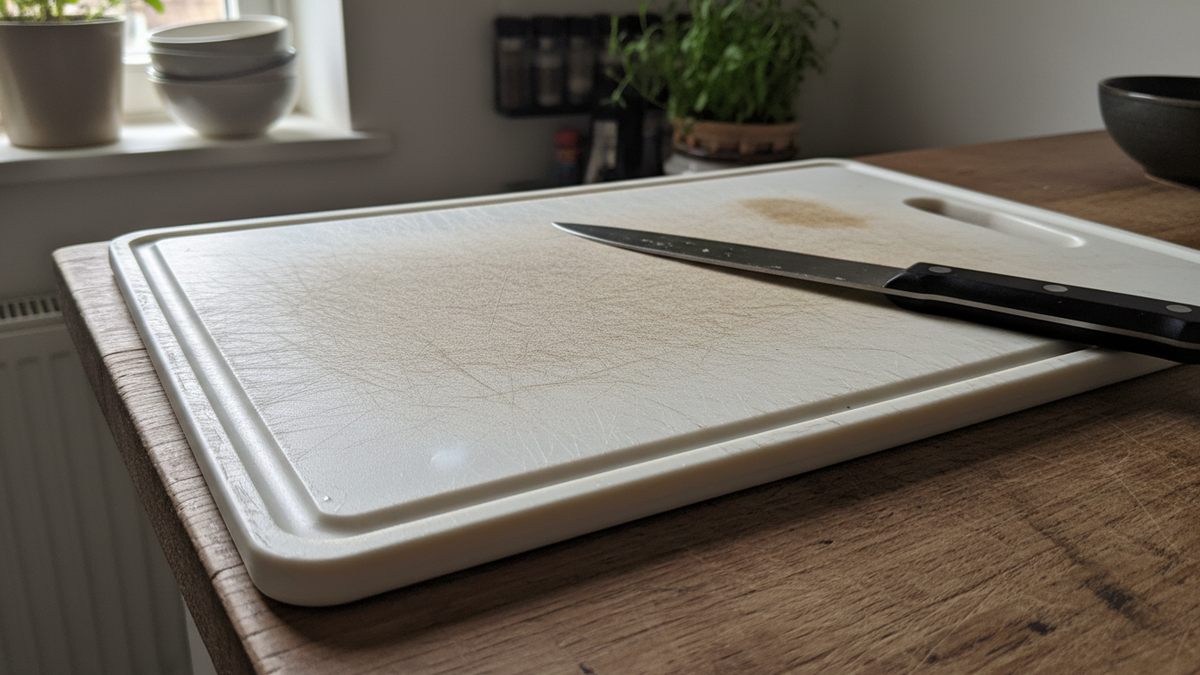
The board I finally threw out
The white plastic board in my kitchen came with the apartment and lasted nine years. By the end the middle of it had gone the color of weak tea, the surface was furred with cuts deep enough to catch a fingernail, and if I ran a thumb across it after chopping something dry I picked up a fine pale dust that was not flour. I kept using it. It was clean, it went through the dishwasher twice a week, and in nine years I had not once wondered where the missing material had gone.
Then I read the research on it, and the first thing worth saying is that the research did not tell me what I expected. It did not tell me the board was dangerous. It told me roughly how much material a board loses under laboratory conditions, and then it stopped, because that is where the evidence stops. Everything after that point is people filling in the blank with whatever they already believed.
What a knife actually does to plastic
Household boards are almost always high-density polyethylene or polypropylene. Both are soft on purpose. A board harder than the blade would wreck the blade, so the board is built to lose the argument, and every pass of the knife shaves something off it. That is not a fault in the board. That is the board doing its job.
The cutting does two separate things, and they compound. It removes material straight away, in fragments that are occasionally big enough to see if the light is low and across the surface. And it opens the surface up, so that the next pass lands in a groove instead of on a flat plane and takes off more than the pass before. An old board sheds faster than a new one. Anybody who has put a five-year-old board next to a fresh one already knows this; the research just puts a number on it.
What has been counted, and how
A team publishing in Environmental Science & Technology in 2023 did the obvious experiment and did it carefully. They chopped on polyethylene and polypropylene boards in a standardized way, weighed each board before the trial and again afterward, rinsed and collected what came off, and counted the fragments under a microscope with a dye that makes polymer glow and food debris not. Then they scaled the result up to a year of ordinary home use.
That is Yadav and colleagues, Environmental Science & Technology, 2023, DOI 10.1021/acs.est.3c00924, and three findings are worth carrying home. Polypropylene boards shed more than polyethylene ones, by fourteen to seventy-one percent on the count. The style of the chopping moves the result as well, and the effect shows up more clearly the longer the chopping goes on. And the annual figures the authors scale to land in the tens of millions of fragments per person per year, which is a number so large that it stops meaning anything and starts functioning as a mood.
There is a second number in the same paper that almost nobody quotes, and it is the more useful one. Scaled the same way, the mass works out at somewhere between seven and fifty grams a year from a polyethylene board. Grams are a unit a person can picture. Tens of millions of fragments is not, which is exactly why the count is the figure that travels.
Why those are ranges and not figures
Four things make the annual numbers softer than they look, and none of them is a criticism of the work.
- The scaling. The measurement covers minutes of chopping. The headline covers a year. Everything between the two is an assumption about how often a household cooks, and households are not alike.
- The counting floor. Below a certain size the microscope simply stops resolving fragments. Every count published anywhere is therefore a floor, not a total, and a newer paper reporting a bigger number often means a better instrument rather than a dirtier kitchen.
- The chopping. A standardized motion in a laboratory is reproducible, which is the point, and it is not how anybody chops an onion at seven in the evening.
- The boards. Cheap boards are frequently made from recycled feedstock with fillers in them, and there is no reason to think two boards from two shops behave the same way.
What nobody has measured
This is the part that most write-ups leave out, so it goes near the top here rather than at the end.
Nobody has measured what fraction of the material that comes off a board actually ends up in the food. Some of it does. Some sits in the grooves until the next wash. Some goes down the sink with the rinse water. The split between those three has not been published, and the whole practical question hangs on it.
Nobody has followed two groups of people, one chopping on plastic and one chopping on wood, and measured a single outcome in either. There is no comparison study. There is no dose and no response, because nothing has been dosed and nothing has been watched.
And nobody can tell you what quantity would matter, which means nobody can tell you whether tens of millions of fragments a year is a lot. It is a big number attached to an unknown scale. Those two facts have to be held at the same time, and most of what is written about boards online holds only the first.
Wood, bamboo, glass, and the trade nobody mentions
The obvious move is to switch to wood, and it is a reasonable move, but it is a trade rather than an upgrade.
Wood sheds too, and here is the part that gets left out of every article that recommends the switch: in the same 2023 work, the wooden boards shed between four and twenty-two times more particles than the plastic ones. What they shed is cellulose, which is what the tree was made of and what a good deal of food is made of, and that is the whole of the argument in wood's favor. It is an argument about what the fragment is, not about how many there are.
The bacteria side runs the other way, and it is older. Ak, Cliver and Kaspar, Journal of Food Protection, 1994, DOI 10.4315/0362-028X-57.1.16, put bacteria on wooden and plastic blocks and recovered far less from the wood after hours, by at least ninety-eight percent and usually more. Their companion paper, DOI 10.4315/0362-028X-57.1.23, found that new plastic cleaned up easily while plastic with extensive knife scars was hard to clean by hand, especially with chicken fat in the grooves. That is a finding about cleaning, not about bacteria thriving in the scratches, and the difference matters. That literature is thirty years old, it has been argued over ever since, and modern kitchen guidance still leans toward plastic for raw meat for one unglamorous reason: plastic goes in the dishwasher and a wooden board does not.
Bamboo boards are laminated strips held together with adhesive, so a bamboo board is a wooden board plus a glue nobody lists. Glass and stone shed nothing at all and destroy the edge of a knife, and a dull knife slipping off a tomato is a more immediate kitchen problem than any of this. Every option on the shelf costs something.
What I changed, and what I did not
I replaced the nine-year-old board, because a surface a fingernail catches on is past the point where washing it means anything. I did not replace the other two.
Wood now does everything that is not raw meat: bread, vegetables, herbs, the tomatoes for Tomato and Bread Salad, anything going onto a plate without being cooked first. Plastic does raw chicken and raw fish and then goes through the dishwasher hot, which is the job it is genuinely better at and the reason I still own one. Nothing about the chicken for One-Pan Lemon Chicken and Potatoes has changed.
I stopped attacking the boards with the green abrasive pad. That pad does across the whole surface, in fifteen seconds, what the knife does along one line, and I had been doing it after every wash for years under the impression that it counted as cleaning. Hot water, a brush, dry standing on its edge. And a board comes out of rotation when a fingernail catches in it rather than when it looks tired, because looking tired is a stain and catching is a groove.
What we still don't know
Four questions, all of them open, and every one of them would change the practical answer if somebody settled it.
- What share of what comes off a board ends up in the food, as opposed to the sink or the grooves.
- What happens to the fragments after they are eaten, which is the only question a reader actually cares about and the one with the least published on it.
- Whether the size range nobody can count yet is the range that matters.
- Whether the cellulose a wooden board sheds behaves differently inside a person from the polyethylene a plastic one sheds. That is the entire case for wood, the fragment counts run against it, and no count can settle it either way.
Until those are answered, the honest position is the dull one: a scratched board sheds, the amount is measurable, nobody knows what the amount means, and replacing a badly grooved board is a cheap thing to do for reasons that are already good enough on their own. Claims Review: The Honey, Garlic and Cinnamon Drink reaches the same place from a completely different aisle, and that is the line this site takes about everything.
Editor's note: this page reports on kitchen equipment and the work published about it. General information, not medical advice; nothing above justifies altering an arrangement made with a clinician.