Claims Review · Home Preparations
Claims Review: The Beet, Lemon and Ginger Morning Drink
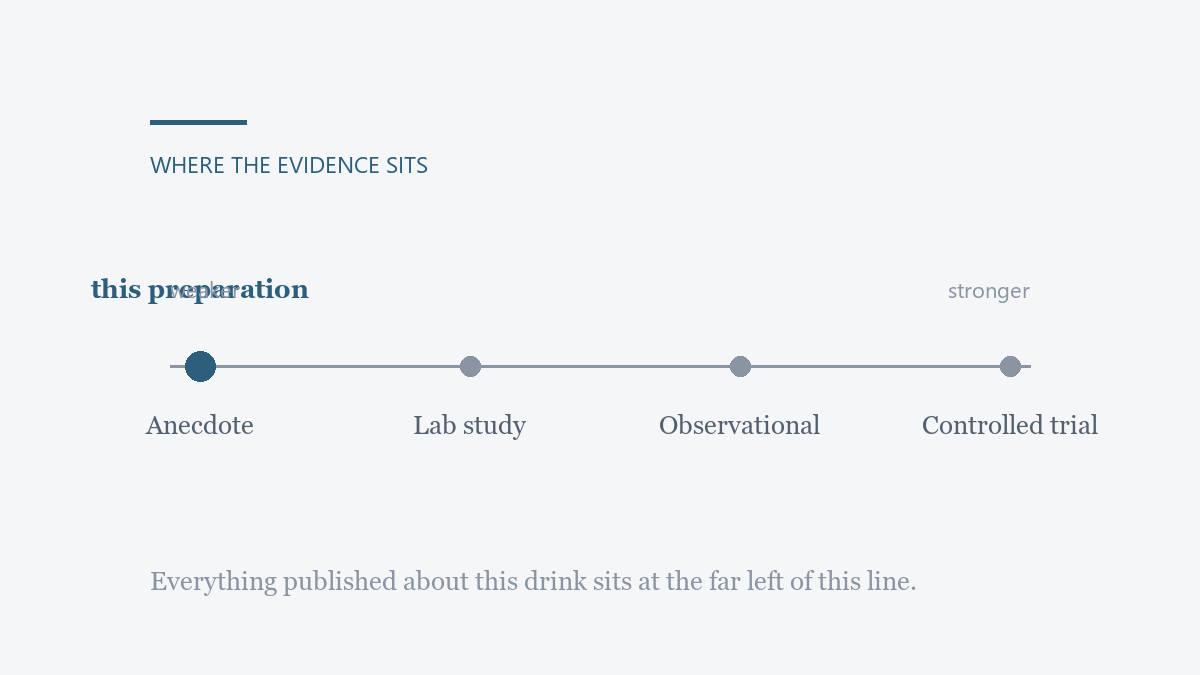
This one arrives in the inbox described as a secret, which is a strange word for something made of three groceries. We wrote it out in full so it stops being one, then took the six claims attached to it and asked of each the same question: did anybody measure this?
Why we looked at this one
Readers forward us home preparations constantly, and lately this one arrives more than any other. It is always framed the same way. Somebody's aunt drinks it, or somebody's neighbour was told about it by a man who used to work in a hospital, and the recipe is passed along as though it were being smuggled.
That framing is the reason we wrote this page. A recipe made of beets, a lemon and a knob of ginger cannot be a secret. It costs about two dollars, it takes four minutes, and the whole thing is written out further down so that nobody has to trade anything for it. What can be checked is the set of statements travelling alongside it, because those statements are unusually specific, and specific is checkable.
We are not here to talk anybody out of drinking beet juice. It is a vegetable. What we wanted to know is how far the sentences wrapped around it have drifted from anything anyone has demonstrated, and the honest answer is that they have drifted a long way.
The six claims, one at a time
1. “It breaks down the hardened deposit inside the artery wall.”
Not supportedMaterial inside a blood vessel either got smaller or it did not, and finding out means imaging somebody, waiting, and imaging them again. That study has not been run on this drink. There is no scan to point at, and there is none pointing the other way either. What exists is a firm sentence about an interior process, offered with nothing underneath it. When a page states this one, notice that it never shows a before and an after, because there is no before and after to show.
It is worth being precise about what has been measured, because the single ingredients have been studied in people and the deposit never has. The trials on beetroot took blood pressure readings, artery stiffness and the response of the vessel lining — numbers taken from outside a person, in minutes. None of them imaged the inside of an artery wall before and after. A claim about material inside a vessel needs that scan, and the scan does not exist for any of these three foods, let alone for them mixed in a jug.
2. “Take the reading on both arms. If the two numbers disagree, the deposit is already there.”
MisreadThis one is worth slowing down on, because unlike the others it starts from something real. A difference between arms is common, it is measured routinely, and clinicians have a threshold at which they look further. All of that is published and none of it is hidden.
What has been added is the part that does not follow. A small gap between arms turns up in plenty of healthy people, it moves with cuff size and arm position and with which arm went first, and it is not a home test for anything. Reading it as proof of a specific deposit, in a specific place, is the leap. If your two arms disagree by a wide margin and it keeps happening, that is a reason to have it looked at properly, and it is not a reason to buy anything or to start any drink.
3. “It reaches what medication cannot reach.”
Not supportedTo say one thing gets somewhere another does not, you need both of them measured arriving. No such comparison exists here, so the sentence rests on nothing at all. This is also the claim on the list with a real cost attached, because a reader who believes it may quietly stop taking something. If that thought has crossed your mind, the conversation belongs with whoever wrote the prescription, and it belongs there before anything changes.
4. “You will see the change in your numbers inside a month.”
No evidenceA statement with a deadline in it implies somebody measured at intervals and watched a line move. We could not find that study. What we did find is that the deadline moves depending on which page you land on: three weeks here, a month there, six weeks somewhere else. A number that changes with the page it appears on was invented rather than recorded.
One thing cuts the other way and belongs here. A trial does exist that put a deadline on a single ingredient: 68 adults with high blood pressure drank 250 mL of beetroot juice a day for four weeks against a nitrate-free beetroot juice built to taste the same, and clinic, home and 24-hour readings all came down — 7.7/2.4 mmHg at the clinic and 7.7/5.2 mmHg across 24 hours, with the effect holding for the whole four weeks (Hypertension, 2015). So a month is not an absurd window for a beetroot preparation, and that is the strongest sentence on this page. It is also a measured daily volume of concentrated juice against a matched placebo, not two beets, a lemon and a knob of ginger, and nobody has run the second study.
5. “It is completely safe because it is only vegetables.”
Partly accurateHalf right, and the half that is right is the larger half. These are groceries, and most healthy adults drink all three without any trouble. Where it goes wrong is the word completely. Food eaten deliberately every morning behaves differently from food eaten now and then, and there is a short list of medications and circumstances worth mentioning first. It is further down, and it is genuinely short.
6. “Doctors are not permitted to recommend food.”
UnfoundedNotice that this claim is not about the drink. It is about a rule that somebody supposedly operates under, and no evidence is ever produced for it, because none could be. Dietary advice is ordinary clinical practice and always has been. A plainer reading is available: clinicians do not raise a specific preparation nobody has studied, for the same reason they do not raise any of the thousands of other things in that category. If you want to know what yours makes of it, ask at the next appointment. It takes a minute.
The short version
Cheap drink, ordinary food, and no reason at all not to make it if you like the taste. The claims wrapped around it are a different matter: they run well ahead of anything demonstrated, and nobody offering them shows their working. Both things are true at once, and a reader deserves to have them separated.
The preparation, written out in full
Here it is, so that nobody has to give an email address or buy anything to find out what the secret was. It takes about four minutes, most of which is peeling.
Two servings
- 2 medium
- raw beets, scrubbed and peeled
- 1
- lemon, juiced
- 1 inch
- fresh ginger, peeled
- 1 cup
- cold water
- optional
- 1 small apple, cored, if you want it less earthy
- Cut the beets into pieces small enough for whatever you are using. A blender wants smaller pieces than a juicer does.
- Blend the beets, the ginger and the water until there is nothing left to catch on a spoon. About ninety seconds in a domestic blender.
- Strain through a fine sieve if you want it thin. Skip this and it is a thick drink instead, which keeps more of the fibre and is the version we prefer.
- Stir in the lemon juice at the end, off the heat and after blending. Add the apple at step two if you are using it.
- Drink it the same day. It separates within the hour, which is normal, and a stir puts it back.
Taken in the morning, before eating, is how it is usually described. Nothing we found suggests the timing matters, and nothing we found suggests it does not.
What the three ingredients have been measured to do, on their own
Everything above is about the drink, and the answer there is that nobody has tested it. That is not the same as saying nothing has been tested. Each of the three groceries has been through human trials on its own, the results are public, and they are more interesting than the claims are — partly because one of the three turns out to have almost nothing behind it. Every identifier below links to its record in PubMed, the public index run by the United States National Library of Medicine, and each was opened on the day of the last review.
Beets
This is the ingredient with real numbers. A review pooling 16 crossover trials in 254 people found systolic pressure 4.4 mmHg lower with inorganic nitrate or beetroot juice, with diastolic not reaching significance; the interventions in it ran from two hours to fifteen days (J Nutr, 2013). The four-week trial in 68 adults with hypertension is described in claim four above (Hypertension, 2015), and it was paid for by a cardiovascular charity rather than by anybody selling anything, which is worth noting because it is not true of every trial on this page.
Two limits travel with those numbers and rarely travel with the claim. The studies used a measured daily volume of juice or a nitrate supplement, not beets in a blender, and how much nitrate a beet carries depends on the soil it grew in. And every endpoint is a pressure reading or an artery measurement: nothing in this literature measured a heart attack, a stroke or a death.
Ginger
Pooling six trials in 345 people gave systolic pressure 6.36 mmHg lower and diastolic 2.12 mmHg lower — and the trials disagreed with each other enormously, with the effect appearing only in the subset of studies in people under 50, running eight weeks or less, at doses of 3 g a day or more (Phytother Res, 2019). A later review in people with type 2 diabetes pooled ten studies, found systolic pressure 4.2 mmHg lower with the same very high disagreement between trials, and found no effect at all on cholesterol or triglycerides (Complement Ther Med, 2022).
Three grams a day is the dose that moved the number. An inch of ginger split between two glasses is not that, and reviews that disagree with themselves this much are a reason to wait rather than to conclude.
Lemon
Here is the finding that surprised us, and it is the reason this section exists. We could not find a single randomised controlled trial of ingested lemon with blood pressure, artery function or blood lipids as a measured outcome. Not one.
Where the citations actually go is worth laying out, because all three are real papers being asked to carry something they do not say. The study usually offered is an observational record of 101 middle-aged women on an island in Hiroshima followed for five months, in which lemon intake and the number of steps walked were both recorded; nobody was randomised to anything, its own authors conclude that the steps and the lemon act through different mechanisms, and two of its authors are from the research division of a food and beverage company (J Nutr Metab, 2014). Then there are two trials of hesperidin, a flavonoid found in citrus peel, given as a capsule. Five hundred milligrams a day for three weeks in 24 people with metabolic syndrome improved the dilation of the brachial artery (J Clin Endocrinol Metab, 2011). Four hundred and fifty milligrams a day for six weeks in 68 overweight adults did not change that dilation at all, which was the outcome the trial was built to measure; the positive findings in it come from a subgroup, and the authors write that their results were not adjusted for multiple comparisons (Am J Clin Nutr, 2016). Two of that trial's authors give a commercial affiliation rather than an academic one.
A capsule of an isolated compound from the peel is not a lemon, and a five-month diary is not a trial. On the lemon, our answer is that nobody has checked.
How we assessed the claims
One test, applied identically six times: is there a published study that measured the thing being claimed, in people, using this preparation?
Two words in that sentence do the work. People, because a result in a dish is not a result in a person. And this preparation, because a trial of a concentrated extract of one ingredient tells you nothing about two beets and a lemon in a jug.
Where no such study turned up, we wrote unsupported. That word is doing something specific and it is worth pausing on: unsupported is not the same as false. An untested claim has not been disproven, it has simply never been checked. What it does mean is that anybody stating it firmly has gone past what is known, and that a reader has no way to verify it even if they want to.
Claim two is the exception on this page, and it is flagged differently on purpose. It is not unsupported. It takes a real, published, well-described observation and attaches a conclusion the observation does not carry. That is a different failure and it deserved a different word.
We did not run any studies ourselves and are not equipped to. If a paper exists that we missed, we would rather fix this page than leave it wrong. The address is at the foot of the page.
Every study named on this page is linked to its record in the public index, and the date of the last source check sits under the headline. If a link fails, or a number here does not match the record it points at, that is a factual correction rather than a quibble: write to us and it gets made, dated, and listed on our corrections page.
The one thing on this page we will state plainly
Nothing here says or suggests that this preparation treats, prevents, cures or lowers the risk of any disease or condition, including anything to do with the heart or circulation. No outcome is promised. Personal accounts published anywhere online are not evidence, and they are not a guide to what will happen to anyone else.
Safety points worth raising with a clinician
Short list, and none of it is alarming. It is here because claim five said completely safe and that word needed answering.
- Medication for blood pressure. Beets come up in this conversation constantly and the drink is taken daily on purpose. That combination is worth a sentence to your prescriber, not because something bad is expected but because they should know what you take.
- A history of kidney stones. Beets are high in oxalate. If you have been told to watch that, this is one to ask about.
- Anything that affects clotting. Ginger appears in that discussion often enough that it belongs on this list. Raise it with your prescriber.
- Surgery or dental work ahead. Teams ask what you take. Something taken every morning and on purpose belongs in the answer, food or not.
- Tooth enamel. A whole lemon a day is acidic. Rinse with water afterwards and do not brush immediately.
- Pink urine the next day. Harmless, common, and it catches people out. It is the pigment from the beets and it is not blood. If you are unsure, that is a question with a two-minute answer at a surgery.
Questions readers sent us
You say unsupported five times. Are you saying it does nothing?
No, and the distinction matters. We are saying nobody has checked. If a good study appears tomorrow showing something, that would not contradict this page; it would fill the hole this page describes.
Why is it always presented as a secret?
Because a recipe framed as withheld travels further than the same recipe framed as a recipe. That is a fact about how things spread online, not a fact about beets. The version above is complete and there is nothing else to it.
My relative swears by it. Does that count for nothing?
It counts as their experience, which is real and is theirs. It cannot tell you what would have happened to them otherwise, and it cannot tell you what will happen to you. That is the whole reason studies are built the way they are.
Is there harm in making it while the question is open?
For most healthy adults, no, beyond the colour. Check the list above first if any of it applies to you, and do not let it displace something a doctor prescribed.
Some pages cite a specific study. Did you look at it?
Yes, and we have now written out where those citations go: the section above lists every human trial we could find on each of the three ingredients, with identifiers. Two things are true at once. The beetroot trials are real and so are the numbers in them. And not one study in the whole set tested this preparation, the lemon has no trial behind it at all, and the ginger dose that moved a number is several times what is in the jug. If you have a study that is about the actual preparation, send it and we will read it.
Will you update this page?
Yes. The review date sits under the headline and moves when the page is checked again.
The other preparation we did this for
A honey, garlic and cinnamon drink circulates with a near-identical set of claims attached, and we put it through the same six questions. The verdicts came out the same way, for the same reason.
Read that review Opens the companion review, published in full.
Correction, November 10, 2026
The reader question above was previously answered with: “Every time we have followed one of those citations it has led to a paper about a single ingredient, usually at a concentration nobody reaches by drinking a glass of anything.” The first half was right and the second was too broad. One of those trials used 250 mL of beetroot juice a day, which is a quantity a person can drink, and it found a fall in blood pressure that held for four weeks. The answer has been rewritten, the trials on each ingredient are now listed with their identifiers, and the verdicts on the six claims — every one of which is about the preparation rather than an ingredient — are unchanged. Listed on our corrections page.
Disclosures
Advertising disclosure. This page carries no advertising links and no affiliate links, and nothing on it is for sale. The recipe is published in full and free. Other pages on this site do carry advertising links, and they are labeled where they appear.
Not medical advice. Everything here is general information. It is not medical advice, it creates no professional relationship, and it does not replace a conversation with a physician or another qualified provider who knows your situation. Bring questions about a condition or a medication to them, and never postpone or ignore their advice because of something read on this site.
Regulatory statement. Claims about dietary supplements have not been evaluated by the Food and Drug Administration. Dietary supplements are not intended to diagnose, treat, cure or prevent any disease.
Individual results. Experiences differ for reasons this publication has no way to assess. No particular outcome is promised, suggested or typical. A personal account published anywhere is that one person's account and predicts nothing for anyone else.
Editorial independence. Editorial staff write these articles. Advertisers see no copy before it goes up and cannot change it afterwards.
Accuracy and updates. Health information moves. This page gets checked again periodically and the date of the last check is printed under the headline. If something here looks wrong to you, write to the address below and it will be looked at.