Claims Review · Home Preparations
Claims Review: The Honey, Garlic and Cinnamon Drink
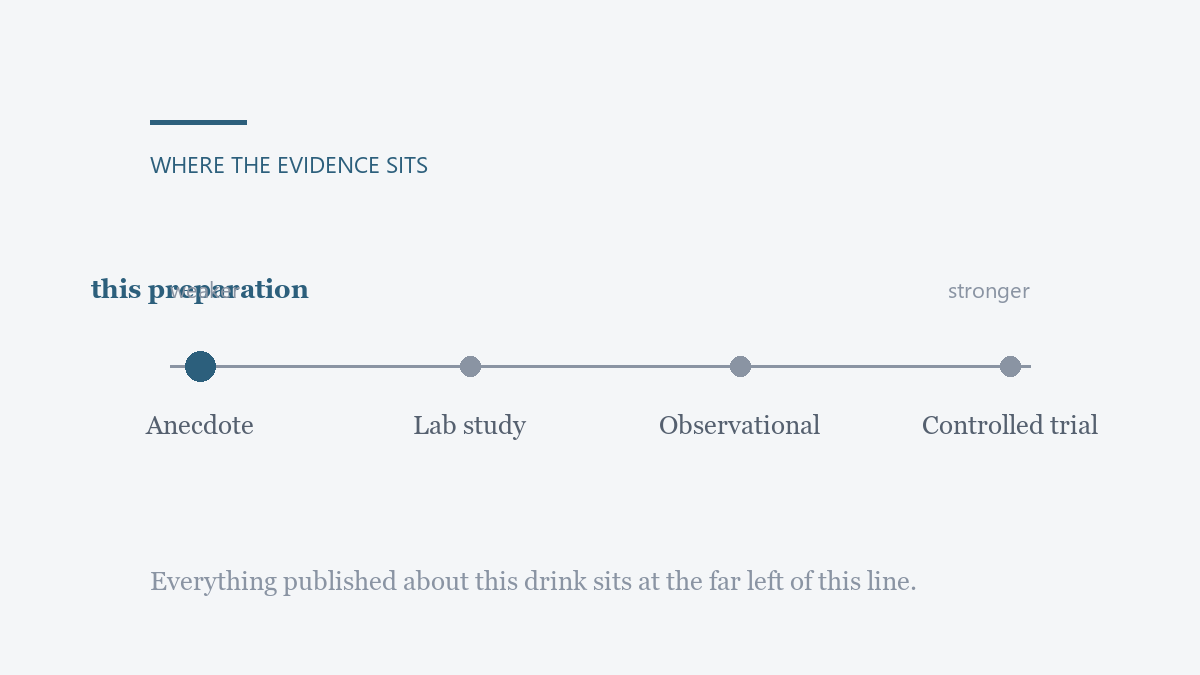
Six things get said about this drink over and over, usually with no source attached. We took each one and asked a single question: has anybody actually measured it? Here is what we found, claim by claim.
Why we looked at this one
Of everything readers send us, home preparations arrive most often, and this one keeps coming back. That is not surprising. It costs pennies, the ingredients are already in the cupboard, and the promises attached to it are unusually concrete. Concrete promises are the checkable kind, which is the only reason a page like this is possible.
To be clear about the purpose: we are not here to talk anyone out of drinking warm water with garlic in it. That is nobody's business but their own. What we wanted to know is how far the things being said about it have drifted from anything anyone has demonstrated. The answer turned out to be: a long way.
Anyone who spends ten minutes searching will see the pattern. Firm statements stacked next to each other, each one phrased as though it were settled, and not one of them carrying a link to where the number came from. That gap is what this page is about.
The six claims, one at a time
1. “It clears out the arteries.”
Not supportedRemoving deposits from a blood vessel is a physical event. Showing that it happened means scanning somebody before and scanning them after. Nobody has run that study on this drink, so there is no picture to point at, and there is none pointing the other way either. What we have is a strong statement about an interior process with no imaging behind it.
2. “Results appear within two weeks.”
No evidenceAny statement with a deadline in it implies somebody measured at intervals and watched a line move. We could not find that study. What we did find is that the deadline itself keeps changing depending on which page you land on, which is what usually happens when a number was invented rather than recorded.
3. “It works better than prescribed medication.”
Not supportedTo say one thing beats another you need the two of them tested side by side. That has not been done here, so the comparison rests on nothing. This is also the one claim on the list with a real cost attached, because a reader who believes it may stop taking something. If that thought has crossed your mind, the conversation belongs with whoever wrote the prescription, and it belongs there before anything changes.
4. “It is completely safe because it is only food.”
Partly accurateHalf right. These are groceries, and most healthy adults eat all of them without incident. Where it goes wrong is the word completely. Food eaten deliberately every morning sits differently than food eaten now and then, and there are a handful of medications and circumstances where it is worth asking first. Those are listed further down, and they are short.
5. “Doctors know about it and do not tell patients.”
UnfoundedNotice that this one is not about the drink at all. It is about what somebody supposedly intends, and no evidence is ever produced for it, because none could be. A plainer reading is available: clinicians do not bring up a preparation that has never been studied, for the same reason they do not bring up any of the thousands of other things in that category. If you want to know what yours makes of it, ask at the next appointment. It takes a minute.
6. “The results are backed by research.”
MisleadingThere is research, and that is exactly why this claim travels so well. It is research on honey, on garlic and on cinnamon considered separately, most of it done to compounds in glassware at strengths a person drinking a mug of this would never reach. Borrowing the credibility of those papers to vouch for a combination nobody has tested is the move being made here, and it is the reason the sentence sounds so much better than the evidence underneath it.
The short version
Cheap drink, ordinary food, and no reason at all not to make it if you want to. The claims wrapped around it are a different matter: they run far ahead of anything demonstrated, and nobody offering them shows their work. Both statements are true at the same time, and a reader deserves to have them separated.
The preparation, written out in full
We publish it here so that nobody has to buy anything to find out what it is. It takes under a minute.
Single serving
- 1 tablespoon raw honey
- 1 clove garlic, peeled and crushed
- ½ teaspoon ground cinnamon
- 6 ounces warm water, not boiling
Warm the water until it is comfortable against the back of your hand. Crush the clove and let it sit a moment. Stir in the honey until the water goes clear, then add the garlic and the cinnamon and stir again. The cinnamon will not dissolve and will settle, so give it a last stir before you drink. Taken in the morning, before eating.
The longer version, with notes on what each ingredient is doing and why the order matters, is on our morning preparation page.
How we assessed the claims
One test, applied identically six times: is there a published study that measured the thing being claimed, in people, using this preparation?
Two words in that sentence do the work. People, because a result in a dish is not a result in a person. And this preparation, because a study of an extract of one ingredient at laboratory concentration tells you nothing about a spoon of honey and a clove of garlic in a mug of water.
Where no such study turned up, we wrote unsupported. That word is doing something specific and it is worth pausing on: unsupported is not the same as false. An untested claim has not been disproven, it has simply never been checked. What it does mean is that anyone stating it firmly has gone past what is known, and that a reader has no way to verify it even if they want to.
We did not run any research ourselves and are not equipped to. If a study exists that we missed, we would rather fix this page than leave it wrong. The address is at the foot of the page.
The one thing on this page we will state plainly
Nothing here says or suggests that this preparation treats, prevents, cures or lowers the risk of any disease or condition, including anything to do with the heart or circulation. No outcome is promised. Personal accounts published anywhere online, comments and testimonials included, are not evidence, and they are not a guide to what will happen to anyone else.
Safety points worth raising with a clinician
Short list, and none of it is alarming. It is here because claim four said completely safe and that word needed answering.
- Anything that affects clotting. Garlic in concentrated form comes up in this conversation constantly. Raise it with your prescriber.
- Blood sugar. Honey is sugar, and a tablespoon before breakfast counts as such no matter what else is in the cup.
- Surgery or dental work ahead. Teams ask what you take. Something taken daily and on purpose belongs in the answer, food or not.
- A stomach that objects to raw garlic. On an empty stomach it objects more. Common, and not a sign of anything happening.
- Pregnancy, nursing, or a child. Honey is never given to infants under a year. For the rest, ask.
Questions readers sent us
You say unsupported six times. Are you saying it does nothing?
No, and the distinction matters. We are saying nobody has checked. If a good study appears tomorrow showing something, that would not contradict this page; it would fill the hole this page describes.
Why not just test it yourselves?
Running a clinical trial takes an institution, an ethics committee and a budget none of which we have. Reporting honestly on what exists is the part we can do.
My relative swears by it. Does that count for nothing?
It counts as their experience, which is real and is theirs. It cannot tell you what would have happened to them otherwise, and it cannot tell you what will happen to you. That is the whole reason studies are built the way they are.
Is there harm in making it while the question is open?
For most healthy adults, no, beyond the taste. Check the list above first if any of it applies to you, and do not let it displace something a doctor prescribed.
Some sites cite a specific study. Did you look at it?
Every time we have followed one of those citations it has led to a paper about a single ingredient, usually in a laboratory setting. If you have one that is about the actual preparation, send it and we will read it.
Will you update this page?
Yes. The review date sits under the headline and moves when the page is checked again.
The step-by-step walkthrough
The companion page walks through the preparation itself, decision by decision, and carries the same safety list. It introduces no findings that are not written here.
Read the walkthrough Opens the walkthrough, published in full.
Disclosures
Advertising disclosure. This page carries no advertising link. Other pages on this site do, they are labelled where they appear, and following one and buying something earns this publication a commission from the seller at no extra cost to the reader. That payment has no bearing on what is written anywhere, and the recipe is published in full, free, whether or not anybody buys anything.
Not medical advice. Everything here is general information. It is not medical advice, it creates no professional relationship, and it does not replace a conversation with a physician or another qualified provider who knows your situation. Bring questions about a condition or a medication to them, and never postpone or ignore their advice because of something read on this site.
Regulatory statement. Claims about dietary supplements have not been evaluated by the Food and Drug Administration. Dietary supplements are not intended to diagnose, treat, cure or prevent any disease.
Individual results. Experiences differ for reasons this publication has no way to assess. No particular outcome is promised, suggested or typical. A personal account published anywhere is that one person's account and predicts nothing for anyone else.
Editorial independence. Editorial staff write these articles. Advertisers see no copy before it goes up and cannot change it afterwards.
Accuracy and updates. Health information moves. This page gets checked again periodically and the date of the last check is printed under the headline. If something here looks wrong to you, write to the address below and it will be looked at.