Home Preparations · Reference Note
Honey, Garlic and Cinnamon: A Traditional Morning Preparation
Three things most kitchens already have, stirred into warm water and drunk before breakfast. The recipe is short, it is written out in full below, and so is an honest account of what is known about it and what is not.
What this preparation is
Ask ten people for this recipe and you will get ten slightly different answers. That is normal for something that traveled by word of mouth long before anyone wrote it down. What stays constant across the versions is the shape of it: something sweet, something sharp, something warm, and water.
It is drunk first thing, before anything else goes in. People who keep it up tend to describe it as a habit rather than a treatment, in the same category as a morning coffee or a glass of lemon water. The measurements below are the ones that come up most often, and they are the ones this kitchen uses.
One thing to be clear about at the top, because the rest of the page depends on it. This is food. It is four grocery items in a mug. Nothing here is offered as a way to treat, prevent or influence any medical condition, and the section on research further down says plainly how little is actually settled.
What goes in it
It helps to know what each item is doing, because that is what tells you where you can substitute and where you cannot.
| Item | Amount | What it is doing |
|---|---|---|
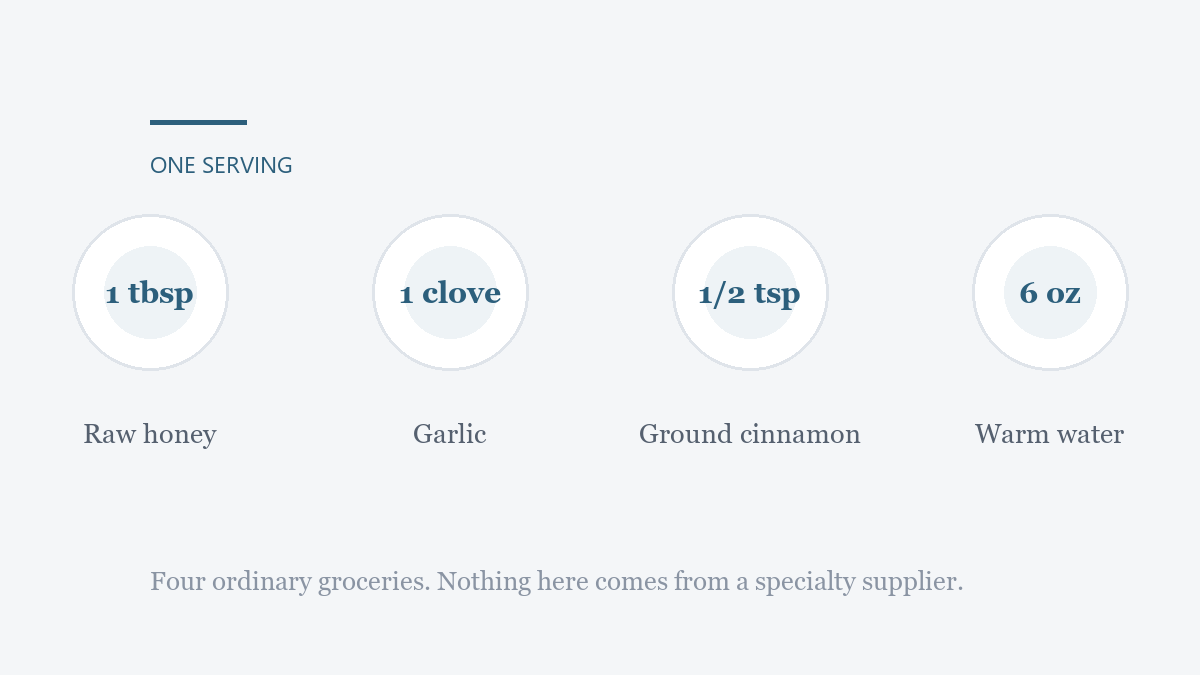
| Raw honey | 1 tbsp | Carries the whole thing. Without it the cup is difficult to finish. Raw or unfiltered is traditional; the jar from the supermarket shelf is what most people reach for. |
| Garlic | 1 clove | The reason the recipe exists and the reason it is hard to drink. Fresh, never the jarred kind in oil, which behaves differently once crushed. |
| Ground cinnamon | ½ tsp | Rounds off the edge the garlic leaves. Cassia from the spice aisle is standard. |
| Water | 6 oz | Warm enough to melt honey, cool enough to sip without waiting. It is the whole method. |
A serving works out to a few cents. Every item keeps for months in a cupboard, which is part of why the recipe spread the way it did.
How it is prepared
Under a minute, start to finish, and the order matters more than it looks.
- Run the tap hot and fill a mug with about six ounces. You want it warm to the back of the hand, not steaming. Very hot water is avoided in the older versions of the recipe, and it also makes the honey harder to taste.
- Peel a clove and crush it flat under the side of a knife. Leave it on the board while you do the next step. Cut garlic changes as it sits, and the pause is in most written versions for that reason.
- Stir a tablespoon of honey into the warm water until the cloudiness clears.
- Drop in the crushed clove and half a teaspoon of cinnamon.
- Stir, then stir again right before drinking. Cinnamon does not dissolve. It sinks, and the last mouthful is grittier than the first no matter what you do.
- Drink it before eating. Most people follow it with plain water.
About the taste
Nobody should go into this expecting to enjoy it. Raw garlic in warm water is sharp, it repeats for an hour or two afterwards, and the cinnamon only takes the top off. If you are the sort of person who quietly abandons anything unpleasant by the third morning, that is worth knowing before you buy a jar of anything.
What the available research does and does not show
This is the part that usually gets skipped, so it is worth being direct. Three questions, in order.
Has this preparation been tested?
Not in any form we could find. There are no controlled trials of these three ingredients, in these amounts, taken this way, over any period of time. What exists is research on the ingredients separately, most of it on isolated compounds in a laboratory rather than on a mug of something a person drinks at seven in the morning.
Does the research on the individual ingredients settle anything?
No. Reviews that gather up the individual studies tend to end the same way: small samples, designs that vary too much to pool, and results that point in different directions. That is a description of an open question, not of a finding. A single promising study is not a conclusion, and a laboratory result is not a prediction about a person.
Then why does it turn up everywhere?
Because it is cheap, it is old, and it is easy to repeat. None of those are evidence. Where you find confident claims attached to this drink online, the confidence is usually the only thing that has been added; follow the citation and it either does not exist or it does not say what the page claims it says.
Stated plainly
No claim is made on this page that this preparation treats, prevents, cures or reduces the risk of any disease or condition, cardiovascular or otherwise. No result is implied. Stories told online about personal experience, including in comments and testimonials, are not evidence and should not be read as what anyone else can expect.
Safety, interactions and who should be careful
These are foods, and healthy adults eat all four of them without a second thought. The reason there is a section here at all is that a food eaten deliberately every morning is a different proposition from the same food eaten occasionally, and a few situations are worth a question to a professional first.
Ask before starting if any of these apply
- You take anything that affects clotting. Concentrated garlic comes up constantly in that conversation. Ask whoever signed the pad, not the internet.
- You manage blood sugar. Honey is sugar. A tablespoon of it before breakfast is a tablespoon of sugar before breakfast, whatever else is in the mug.
- You have surgery or dental work coming up. Surgical teams ask what you are taking, and the honest answer includes anything taken on purpose and daily, food included.
- Raw garlic disagrees with your stomach. On an empty stomach it disagrees more. That is common, and it is not a sign of anything working.
- You are pregnant, nursing, or making this for a child. Honey is not given to infants under twelve months. Ask a professional about anything else on this list.
Common questions
Does it have to be raw honey?
The traditional versions say raw, and that is what we have written. Whether it makes any practical difference here is not something the research answers. Ordinary honey is what most people actually use.
Can I use garlic powder instead?
You can, and it is easier to drink. It is also not the recipe. If you are going to make it, make it with a fresh clove and judge it on that.
Why not just swallow the clove whole?
Some people do. The written versions crush it, and crushing is what produces the sharpness. Swallowing it whole gives you a gentler drink and a different one.
Morning, or does it matter?
Every version we have seen says morning, before eating. There is no evidence that the timing does anything. It is simply how the recipe has always been described, and a habit attached to a fixed point in the day is an easier habit to keep.
How long before I notice something?
That is the question we cannot answer, and neither can anyone else honestly. There is no established effect to notice, so there is no timeline for noticing it.
Can I make a batch for the week?
We would not. Crushed garlic sitting in sweetened water for days is a food safety question, not a flavor one. It takes forty seconds. Make it fresh.
Disclosure
This page carries no advertising link, and nothing on it is a recommendation to buy anything. Other pages on this site do carry them, labelled where they appear; if a reader follows one and buys something, this publication is paid a commission by the seller.
This article is general information about food. It is not medical advice and it is not a substitute for a conversation with a licensed professional who knows your history. Do not start, stop or change a prescribed medication because of anything you read here.